

TL;DR — skydiving disciplines at a glance:
- Tandem jump (from 4,000 m) and Oxygen Jump (from 5,500 m) — available to anyone without prior experience, attached to a certified instructor.
- AFF training — a structured program that ends in a USPA/FAI certified international A-license and fully independent jumps.
- Formation skydiving (FS), freefly, wingsuit, canopy piloting (swooping), accuracy landing, and CRW — competitive sport disciplines for licensed skydivers, each with their own experience threshold.
- BASE jumping is not traditional skydiving — it is a related extreme discipline performed from fixed objects.
- In Latvia, every discipline starts with a tandem jump at Limbažu Airfield. Further progression runs through AFF and then a chosen specialization.
Skydiving is not one activity — it is a collection of disciplines in which a person controls their body in freefall and under canopy in very different ways. This article is a systematic guide to the types of skydiving: from a first tandem jump to the sport disciplines practiced by licensed jumpers worldwide. It is an educational resource — not a sales pitch — for anyone who wants to understand what the sport actually looks like.
Contents
- How are skydiving disciplines classified?
- Tandem jump — entry point to the sky
- Oxygen Jump — high-altitude tandem
- AFF training — path to an independent license
- Formation Skydiving (FS)
- Freefly
- Angle flying and tracking
- Wingsuit flying
- Canopy piloting (Swooping)
- Accuracy, CRW and other disciplines
- BASE jumping — related but separate
- Full comparison of all types
- How to start in Latvia
- Frequently asked questions
How are skydiving disciplines classified?
In practice, skydiving disciplines fall into three broad categories. The first is beginner disciplines: tandem jumping and the stages of AFF training. These are accessible to people without a license and are performed with direct instructor presence in the air. The second category is freefall sport disciplines: formation skydiving, freefly, wingsuit, tracking, and others. Here the jumper controls their body in various positions to achieve a specific goal — from team formations to speed records. The third category is canopy disciplines: swooping, canopy formation work (CRW), and accuracy landing. These focus on what happens after the parachute opens.
Each discipline requires its own training path. USPA and most national federations, including the Latvian Skydivers Federation (LIF), use license levels (A, B, C, D). Each level unlocks access to more advanced disciplines. For example, wingsuit flying requires at least 200 jumps within the last 18 months or 500 total jumps before a wingsuit first-jump course. Canopy piloting (swooping) typically begins after several hundred independent jumps and is one of the most technically demanding disciplines in the entire sport.
Tandem jump — entry point to the sky
The tandem system was developed in the 1980s in the US and is today the most common method for giving beginners a safe freefall experience. The instructor wears a two-person tandem parachute with a larger canopy than a standard sport rig, plus automatic activation devices (AAD) that would deploy the reserve parachute if the primary deployment procedure failed.
Before the jump, the passenger receives a 15–20 minute briefing: how to behave in the aircraft, the correct freefall body position (the "arch"), and how to prepare for landing. After exit from around 4,000 m, freefall lasts about 60 seconds. Once the canopy opens at around 1,500 m, the descent lasts another 5–7 minutes, during which the instructor often lets the passenger hold the steering toggles.

In Latvia, a tandem jump at Skydive Latvia costs €249 for full online booking or €30 as a reservation with the balance due at the airfield on jump day. An optional photo/video operator — who jumps alongside you and captures the whole experience — costs €89. An upgrade to 4,809 m (the altitude of Mont Blanc) is available as an add-on for roughly 15 more seconds of freefall.
Participation requirements: minimum age 16 (with parental consent) or 18, maximum weight 105 kg, with height and weight proportional per the detailed table. Season in Latvia runs April through October; jumps do not take place in winter due to weather.
Oxygen Jump — high-altitude tandem
Technically Oxygen Jump uses the same tandem rig as the standard version — just at a higher altitude. The main difference is aircraft climb time (about 25–30 minutes up to 5,500 m) and oxygen requirements. FAA and EASA regulations require supplemental oxygen for passengers and crew above 3,800 m if they remain there for more than 30 minutes. In practice, Skydive Latvia uses a Pilatus Porter PC-6/B2-H4, an aircraft designed for high-altitude operations.
Oxygen Jump is priced at €490 and includes the oxygen equipment, jumpsuit, video, and photos. Weight, age, and health requirements are identical to the standard tandem. The jump is used as a special gift or personal experience for those who want extended freefall and, in clear conditions, a view stretching across the Baltic coastline.

AFF training — path to an independent license
The AFF program is structured across seven levels (Level 1–Level 7), in which the student gradually masters more complex freefall tasks. On the first jump, two certified instructors hold onto the student's jumpsuit in the air. The student deploys their own parachute at a set altitude, demonstrates body stability, and controls the canopy descent. Each subsequent level removes one layer of dependency — two instructors, then one, then a jump with no physical instructor contact.
The theoretical course covers parachute system operating principles, reserve deployment procedures, emergency scenarios (for example, malfunction recognition and response), meteorology, aerodynamics, and safety rules. Skydive Latvia offers the AFF theory course from €40; the full AFF training program starts at €1,790. Earning an A-license beyond the seven AFF levels requires additional independent jumps — USPA standards require 25 jumps in total for the A-license.

Before their first AFF jump, many students use a wind tunnel (indoor skydiving) to pre-learn body stability in freefall position. A wind tunnel generates an airflow above 200 km/h that simulates freefall, but inside a vertical chamber. It is a crucial training tool — it allows practice in any season and in any weather. In Latvia, wind tunnel facilities are available at Aerodium in Sigulda.
More detail on becoming a skydiver and on common questions about the AFF process is available in separate materials. Skydive Latvia is the only location in the Baltics where you can obtain a USPA/FAI certified license.
Formation Skydiving (FS)
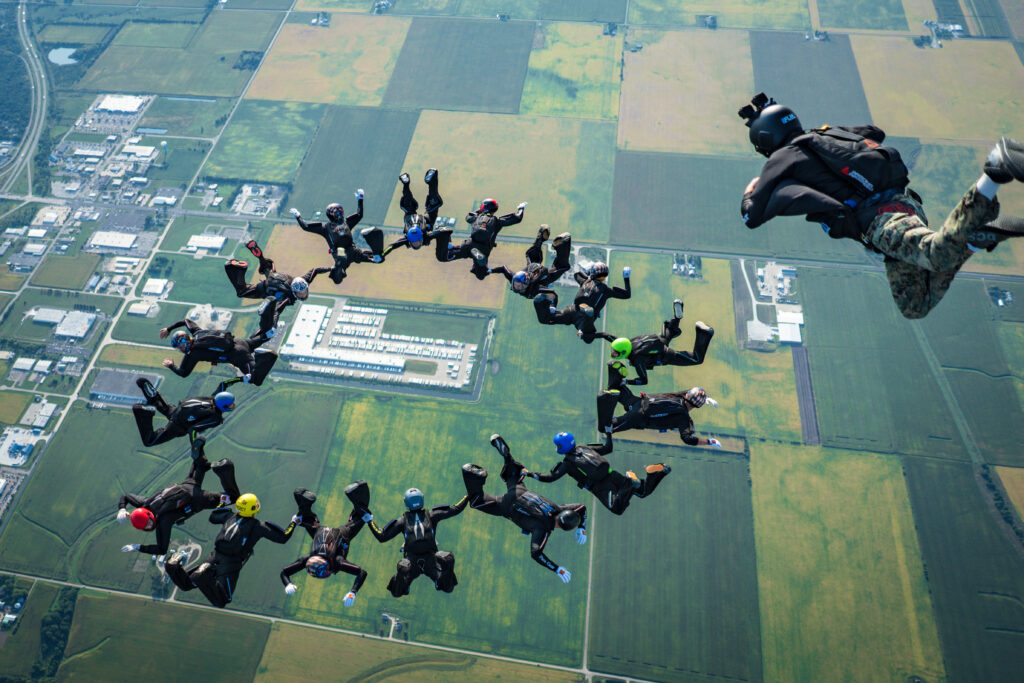
FS competitions judge how many predetermined figures ("points") a team can complete within the working time — usually 35 seconds of freefall. Each figure is recorded on video, and judges review the footage to confirm that each grip is correct and the formation matches the standard. It is a team sport where one unstable jumper can break the team's entire result.
To begin FS training, a jumper typically needs an A-license (around 25+ jumps) plus coached training. Many professional FS team members accumulate thousands of jumps over their careers. In Latvia, FS training takes place regularly with Skydive Latvia sport jumpers — more on the community side is available in the sport and funjumpers section.
Formation Skydiving (FS) — key facts
Freefly
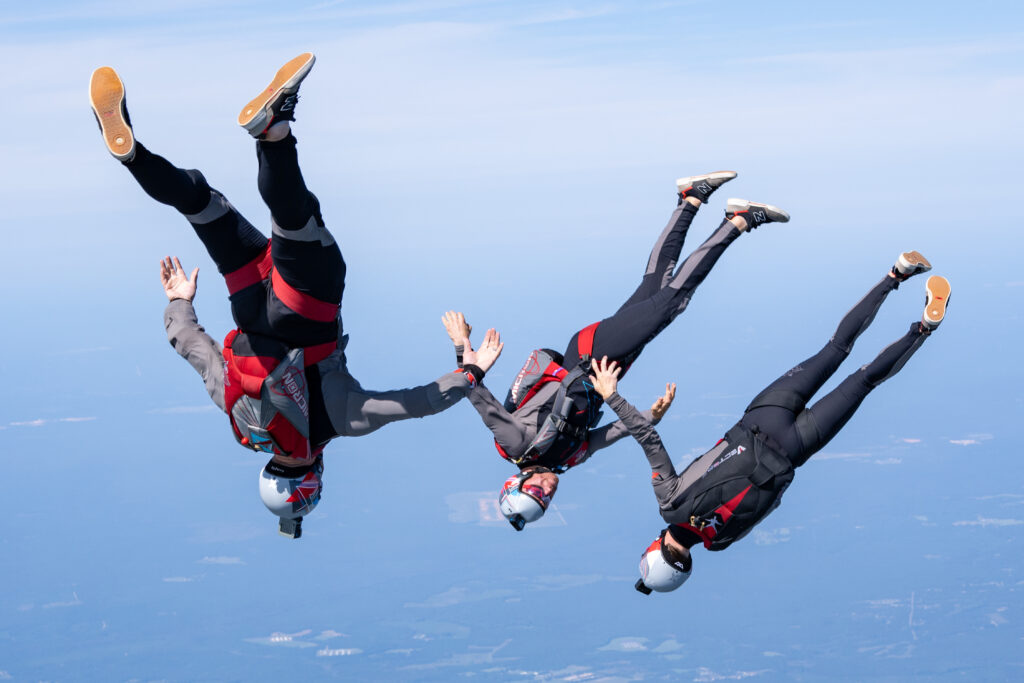
Freefly developed in the 1990s as a "second generation" of skydiving sport — a reaction to the technical saturation of FS formation work. Pioneers like Olav Zipser (France) and Omar Alhegelan (Saudi Arabia/US) experimented with vertical positions and discovered that a person can control their fall while standing or head-down. Today, freefly is a separate FAI competition category with two-person teams plus a cameraflyer performing choreographed sequences and creative routines.
Technically, freefly requires a significantly higher level of body control because speeds are greater and an unstable position can quickly lead to loss of control. USPA and LIF recommendations for starting freefly include wind tunnel training to master head-up and head-down positions in a safe environment. The Latvian team in 2026 reached Latvia's first head-down freefly record, demonstrating growth of the discipline in the region.
Freefly — key facts
Angle flying and tracking
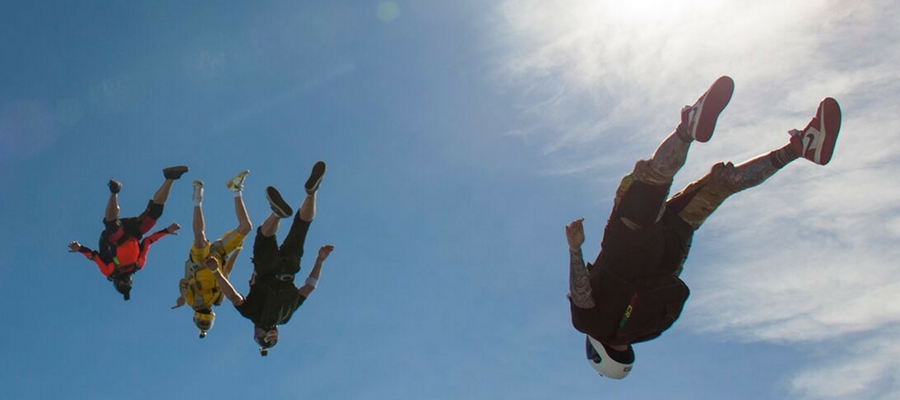
Tracking is the technical foundation — arms held close to the body, legs straight, head tucked — creating a side-profile similar to a flying bird. Angle flying evolved from tracking by adding group formations and dynamic movement control. The discipline is relatively new and is currently one of the few for which no official FAI competition exists, although national competitions do take place in some countries.
Tracking skills are also a safety matter — every jumper learns tracking during AFF so they can separate from other jumpers before deploying their parachute. Tracking is therefore considered one of the core skills learned in the first independent jumps.
Tracking and angle flying — key facts
Wingsuit flying — the human bird
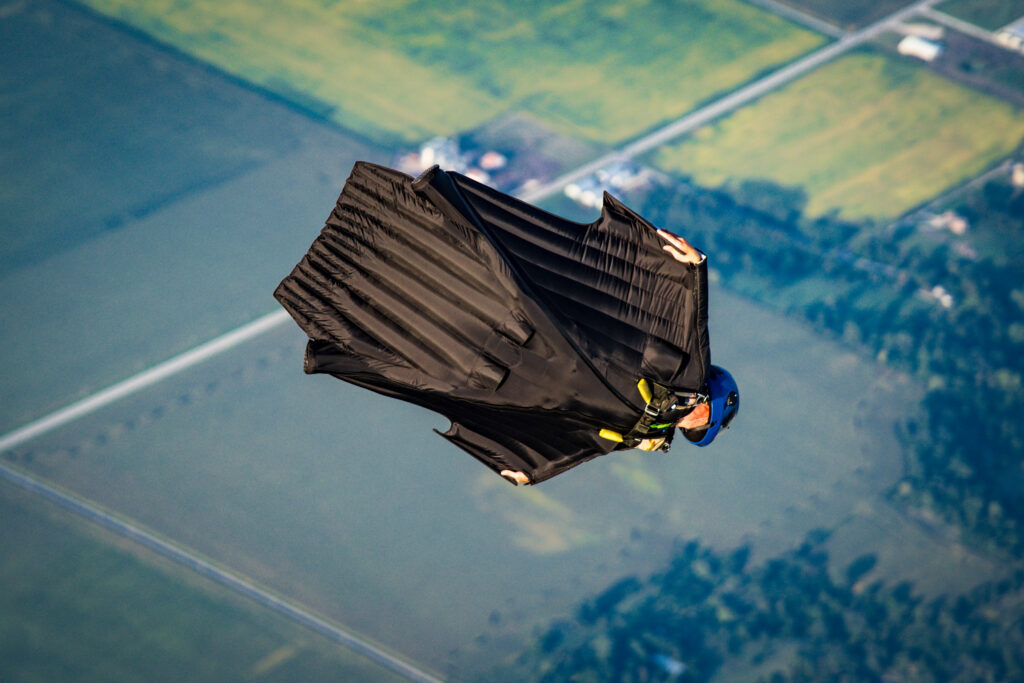
Modern wingsuits are designed to achieve glide ratios of more than 3:1 — meaning that for every meter of descent the flyer travels three meters horizontally. The first wingsuit concept was patented by Frenchman Patrick de Gayardon in the 1990s; today manufacturers like Squirrel and Phoenix-Fly produce a wide range of models for different flight styles — from beginner suits to extreme "suit fly" gear for professionals.
Wingsuit competitions include speed, distance, and time disciplines, with jumpers measured by GPS sensors during freefall. There is also performance flying — judged on flight efficiency — and acrobatic wingsuit, in which two flyers with a cameraflyer perform rotations and formations. Wingsuit is not BASE jumping — traditional skydiving wingsuit flying is always performed from an aircraft with proper canopy deployment in the air.
Wingsuit flying — key facts
Canopy piloting (Swooping)
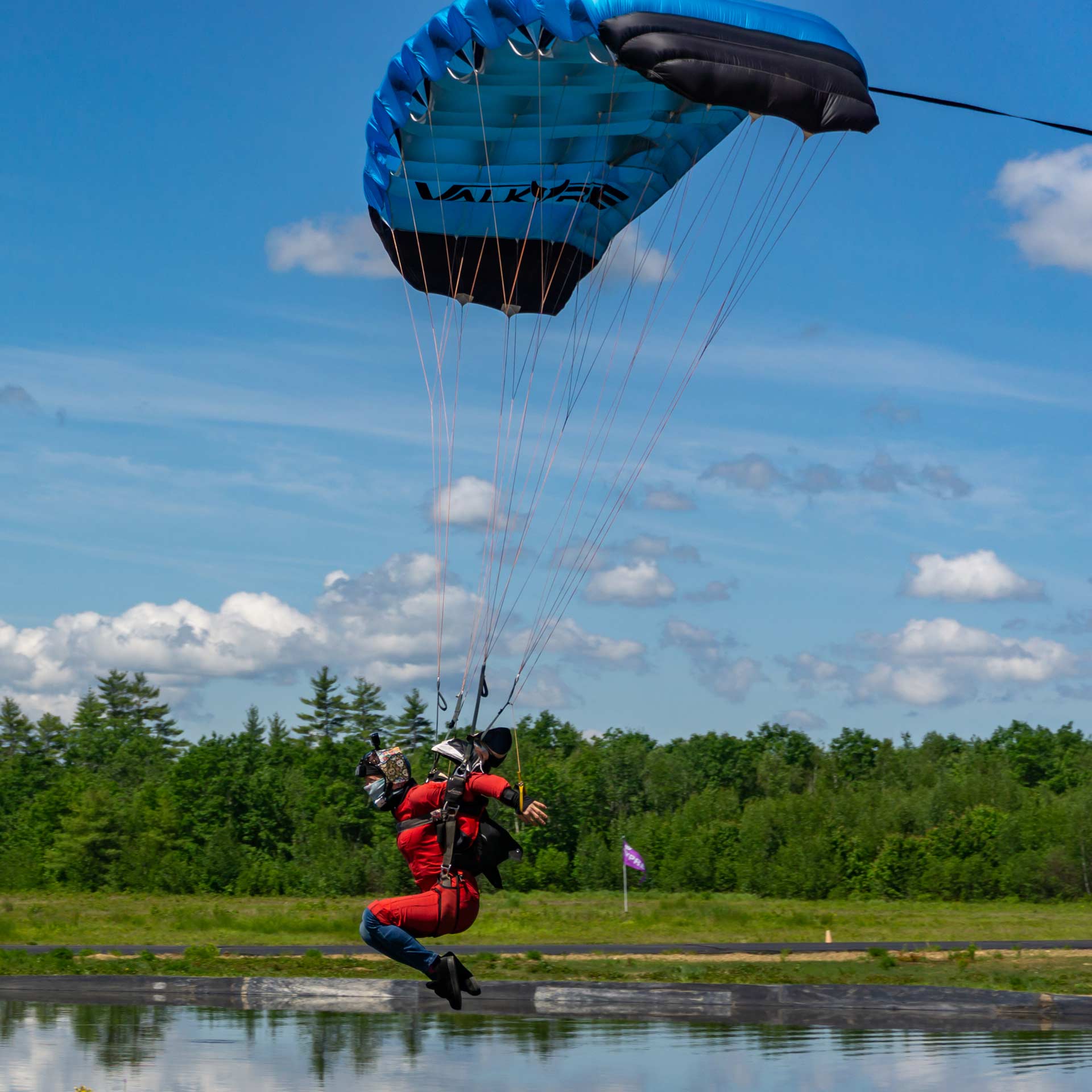
Swooping canopies are extremely small — 25–80 square feet of surface — compared to a standard sport canopy of 150–210 square feet. Smaller surface means faster descent and minimal error tolerance. FAI competitions are held in three disciplines: distance (how far the jumper can travel), speed (how quickly they pass through a 70 m gate), and accuracy (precision in a 2×2 m landing zone). Competitions typically take place over a water pond, which competitors may touch with a foot but must not fall into.
Swooping is considered one of the most dangerous skydiving disciplines — high speeds close to the ground leave very little margin for error. Progression to swooping therefore typically requires several hundred to a thousand independent jumps plus specialized coaching. In the US, the United States Canopy Piloting Association (USCPA) governs this discipline.
Canopy piloting (Swooping) — key facts
Accuracy, CRW and other disciplines
Accuracy landing
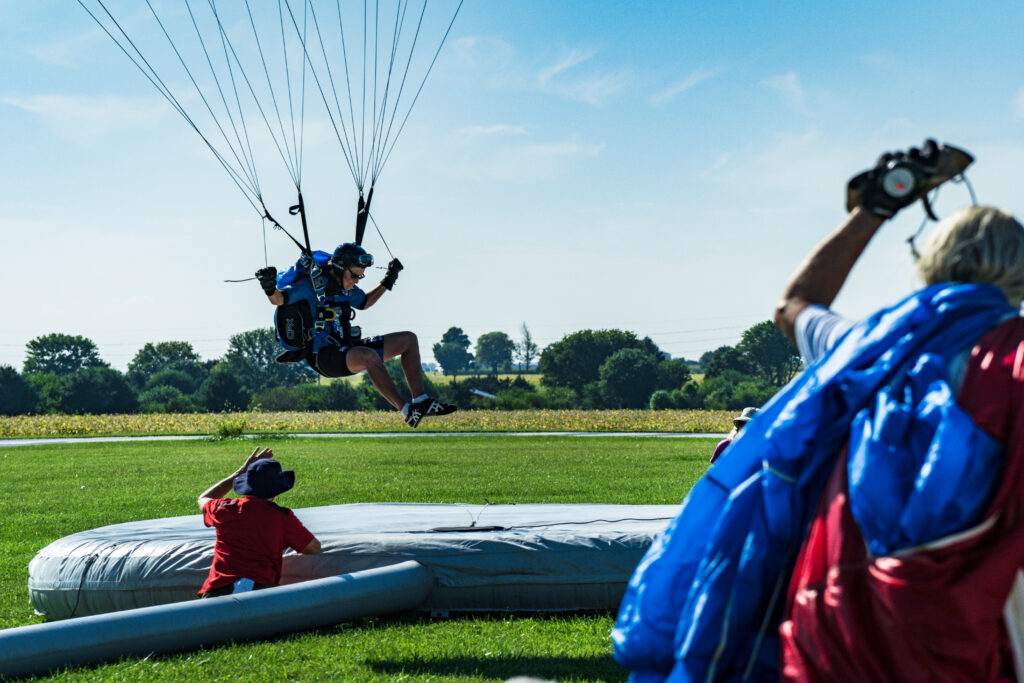
One of the oldest skydiving disciplines — the first documented competitions were in the USSR in the 1930s. Jumpers touch down on an electronic "dead center" target only 2–3 cm across. The best modern accuracy jumpers can land regularly with a 0 cm deviation. Competitions are held individually and in four-person teams.
Canopy formation (CRW / Canopy Relative Work)
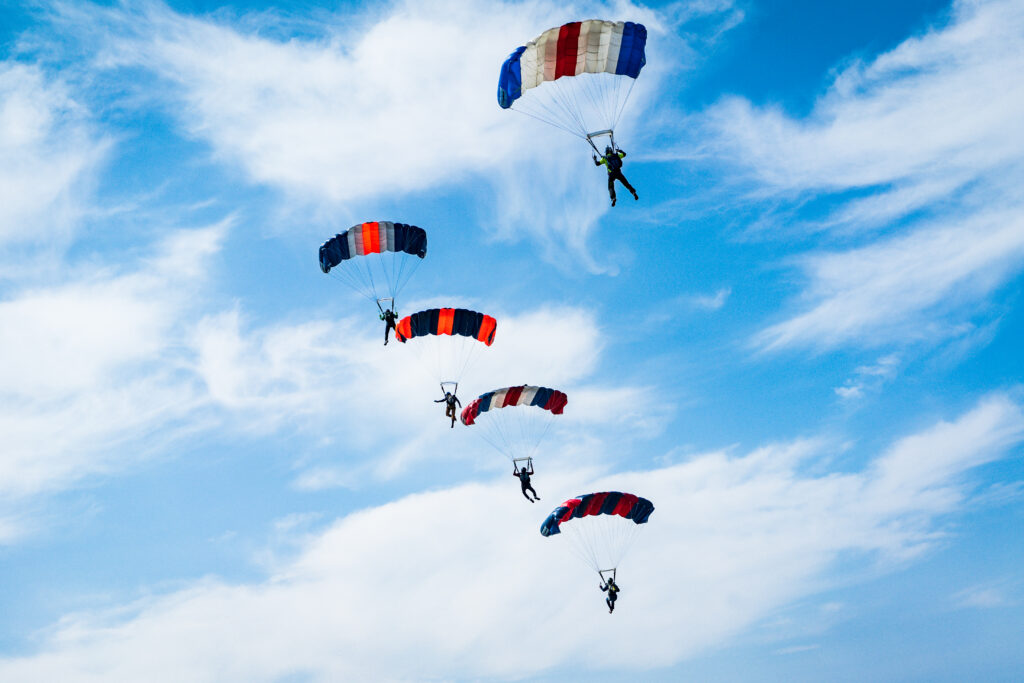
Jumpers deploy their canopies immediately after exiting the aircraft (typically from 3,000–4,000 m) and then link their parachutes together in the air, forming aerial formations. Teams typically consist of 2, 4, or 8 jumpers. There are three main competition formats: rotations (quick spins), sequential (ordered figures), and speed. CRW demands precise canopy control and strong team coordination.
Speed skydiving
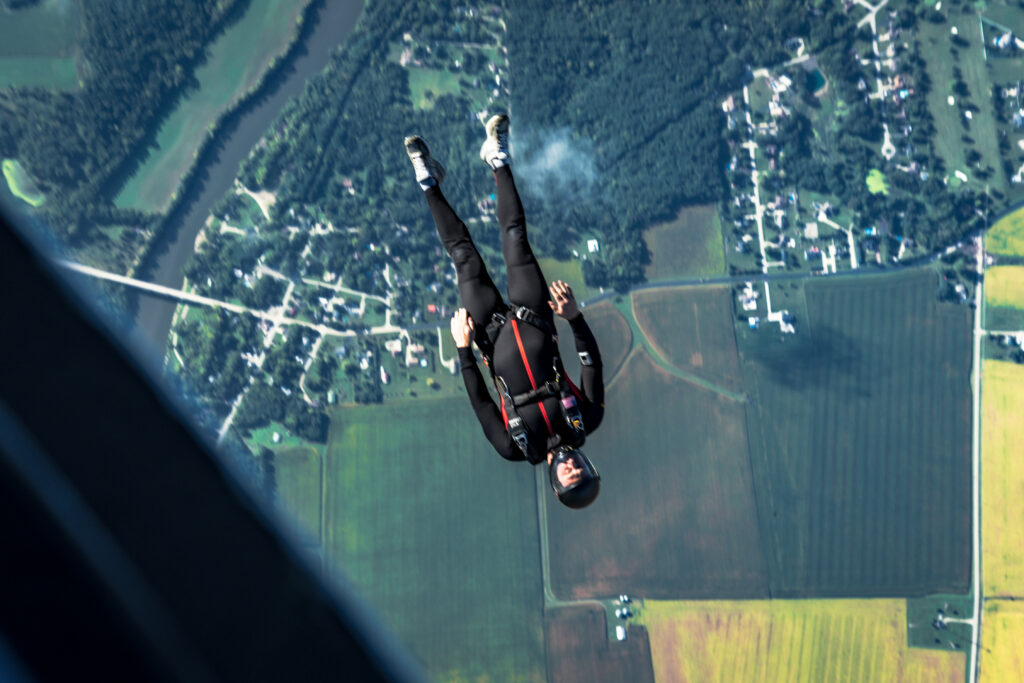
A speed discipline in which the jumper exits at 4,000 m and minimizes aerodynamic drag to achieve maximum velocity. A GPS sensor on the helmet records average speed across the 2,200–1,700 m altitude band. World records exceed 500 km/h — making it the fastest non-motorized sport on Earth. Requirement: USPA B-license or equivalent.
BASE jumping — related but separate
BASE jumping emerged in the late 1970s in the US when Carl Boenish began documenting jumps from fixed objects. The discipline is regulated separately from classical skydiving — FAI does not officially recognize it, and most countries address BASE through their own legislation, either as illegal or heavily restricted. BASE jumps from buildings and bridges are often unlawful without explicit permission.
Technically, a BASE jump is challenging because the jumper has very little time to deploy (usually 2–5 seconds of freefall), and the object's wall or cliff is often close and must be avoided. BASE wingsuit flying is a separate sub-discipline in which jumpers fly in close proximity to cliff walls — an extremely dangerous discipline with a high fatality rate. BASE is not regularly practiced in Latvia, and Skydive Latvia does not offer it.
BASE jumping — key facts
Full comparison of all types
To make the differences easier to grasp, the main disciplines are summarized in a single table. Note that speed and altitude figures are approximate — they vary in specific situations.
| Discipline | Experience required | Speed | Altitude | Focus |
|---|---|---|---|---|
| Tandem jump | None | ~200 km/h | 4,000 m | Beginner experience |
| Oxygen Jump | None | ~220 km/h | 5,500 m | Extended freefall |
| AFF training | Beginner with intent | ~200 km/h | 3,000–4,000 m | Earning a license |
| Formation skydiving | A-license | ~200 km/h | 4,000 m | Team formations |
| Freefly | 200+ jumps | 220–300 km/h | 4,000–4,500 m | Vertical orientations |
| Tracking / angle | A-license | Up to 320 km/h horiz. | 4,000 m | Horizontal movement |
| Wingsuit | 200+ jumps in 18 mo. | 150–250 km/h horiz. | 4,000 m+ | Glide flight |
| Canopy piloting | 500+ jumps | 120+ km/h | 800 m (deploy) | Fast descent |
| Accuracy | A–B license | Descent only | 1,000–1,500 m (deploy) | Target precision |
| CRW | B-license | Descent only | 3,000–4,000 m | Canopy formations |
| Speed skydiving | B-license | 500+ km/h | 4,000 m | Speed records |
| BASE jumping | Unofficial, 200+ jumps | ~200 km/h | 50–1,000 m | Fixed objects |
How to start in Latvia
In Latvia, practically every skydiving journey starts in one of two ways: with a tandem jump or with AFF training. A tandem jump is a one-time experience without further commitment; AFF is a structured program that ends in an international license and the ability to jump independently anywhere in the world. Once licensed, access opens up to every other discipline — formation skydiving, freefly, wingsuit, swooping — depending on your area of interest and how much tunnel time you invest.
Skydive Latvia is the only USPA/FAI certified skydiving organization in the Baltics, operating at Limbažu Airfield (roughly a one-hour drive from Riga). Tandem jumps, full AFF training, and regular sport jumping all take place here during the season from April to October. If you want to explore other adventure options in Latvia — activities or gift ideas — take a look at our extreme activities overview.
Below is a video showing what a real tandem jump looks like from the passenger's perspective — it is the easiest way to get a feel for a first jump before experiencing it yourself.
If you want to use this article as a gift idea source for someone close to you, Skydive Latvia gift cards have no expiration date — they can be redeemed in any future season. More on gift options in Latvia is available in our gift ideas generator.
Frequently asked questions
What are the main types of skydiving?
The main types of skydiving are tandem jumping, AFF training, formation skydiving (FS), freefly, tracking, wingsuit flying, canopy piloting (swooping), accuracy landing, canopy formation (CRW), and speed skydiving. BASE jumping is a related but separate extreme discipline that does not take place from aircraft.
Which type of skydiving is suitable for a complete beginner?
Two types are available for beginners without experience: a tandem jump (including the 5,500 m Oxygen Jump) and the first level of AFF training. A tandem jump only requires a 15–20 minute briefing. AFF begins with a full-day theoretical course before the first jump.
How fast can you fall in freefall?
In classic belly-to-earth position, fall speed is about 200 km/h. In head-down freefly position, speed reaches 250–300 km/h. In the speed skydiving discipline, world records exceed 500 km/h. Wingsuit jumpers reduce vertical speed and convert it into horizontal flight.
What is an AAD and is it mandatory?
An AAD (Automatic Activation Device) is an electronic device that automatically deploys the reserve parachute if the jumper has not deployed it themselves at a predetermined altitude. AADs are mandatory on tandem jumps at all USPA/FAI compliant clubs. For sport jumping, AADs are strongly recommended and effectively mandatory at most clubs.
How many jumps are needed to start wingsuit or swooping?
Wingsuit flying requires at least 200 jumps within the last 18 months or 500 total plus a first-jump course, per USPA. Swooping typically begins after 500+ independent jumps with specialized coaching. These are high-risk disciplines that cannot be started immediately after AFF.
What is the difference between a tandem jump and Oxygen Jump?
Technically the tandem rig is identical. The difference is altitude: a standard tandem is from 4,000 m with about 60 seconds of freefall. Oxygen Jump is from 5,500 m with about 90 seconds of freefall. Because of the higher altitude, oxygen masks are used inside the aircraft during the climb. Oxygen Jump is the highest civilian tandem jump in Eastern Europe.
Is skydiving dangerous?
Per USPA data, in 2023 roughly 3.88 million jumps were made in the US with 10 fatalities — about 1 per 388,000 jumps. Tandem jump statistics are even safer: roughly 1 fatality per 500,000 tandem jumps. Risk varies by discipline: swooping and BASE jumping are significantly riskier than classical FS.
What is the skydiving season in Latvia?
The skydiving season in Latvia generally runs April through October. In winter, conditions — wind, low cloud cover, sub-zero temperatures — make jumping unsafe or impossible. Skydive Latvia's season typically closes in November and reopens in April.
Can you earn an internationally recognized skydiver license in Latvia?
Yes. Skydive Latvia is the only location in the Baltics where you can obtain a USPA (United States Parachute Association) and FAI (Fédération Aéronautique Internationale) certified A-license. This license is recognized worldwide and allows independent jumping at any internationally certified skydiving club.

Author: Aleksandrs Tuls — skydiving coach, Skydive Latvia.