

Updated: March 2026 | Last reviewed: March 2026
Fear of heights — acrophobia — affects roughly 3–6% of the world's population, yet it's one of the most successfully treated phobias, with cognitive behavioral therapy showing 90–95% success rates. And here's a paradox most people don't know: a tandem skydive from 4,000 meters doesn't actually trigger acrophobia — because at that altitude, the brain has no visual depth cues to activate the fear response. That's why it's the best first step, not the last.
What is acrophobia and is it normal?
Acrophobia is a persistent, disproportionate fear of heights that exceeds normal caution — roughly 30% of adults experience non-clinical height intolerance, and around 5% have full-blown phobia. These figures come from research by Huppert, Grill & Brandt, published in PubMed Central.
Normal caution at heights is an evolutionary gift. Acrophobia starts where fear interferes with daily life — refusing trips, avoiding balconies, being unable to cross a bridge. Symptoms include rapid heartbeat, sweating, dizziness, and muscle tension even in objectively safe situations like standing near a window on an upper floor.

Gauja valley from above. Interestingly, this view with clear visual depth triggers fear — but from 4,000m the landscape looks like a flat map and fear doesn't activate.
Why do we fear heights? The science
Fear of heights is biologically hardwired. The classic Gibson & Walk "visual cliff" experiment (1960) demonstrated that infants aged 6–14 months already recognize and avoid perceived depth. Babies placed on a glass surface refused to crawl across a visible drop-off, even when their mothers called from the other side (Gibson & Walk, 1960, Scientific American).
The key insight: the fear mechanism is triggered not by height itself, but by visual depth cues — the brain compares your position to the visible ground and calculates fall risk. The closer the ground is visible, the more intense the reaction. This is why 20 meters triggers stronger panic than 4,000 meters — from 4 km up, the landscape looks like a flat map and the brain has nothing to compare against.
At the neurological level, the amygdala — the brain's threat assessment center — overactivates, producing the "fight or flight" response. The good news: meta-analyses confirm that exposure therapy is the most effective approach for phobias, with large effect sizes (Bandelow et al., 2015; Carl et al., 2019 — ScienceDirect).
How to tell acrophobia from vertigo
Vertigo is a medical condition causing dizziness and balance disruption; acrophobia is an emotional response that only appears at height and vanishes in a safe place. Vertigo can strike on flat ground. If dizziness occurs without a height context — sitting on a couch, turning in bed — see a doctor, as it may relate to inner ear problems.
What methods help overcome acrophobia?
The most effective approach is cognitive behavioral therapy (CBT) combined with exposure — studies show 90–95% success rates. A meta-analysis (Carl et al., 2019, Frontiers in Psychology) calculated effect sizes of 0.79–1.42 Cohen d for VR exposure therapy — a large clinical effect.
Main methods:
- CBT + exposure — the gold standard. Teaches recognizing irrational thoughts and gradually confronting fear. Effectiveness: 90–95% (Nature Scientific Reports, 2024).
- Virtual reality (VR) therapy — comparable effectiveness to in-person exposure (PMC/JAMA Network Open, 2019).
- Breathing techniques — the 4-7-8 method reduces stress response within minutes.
- Mindfulness — grounding techniques help manage panic moments.
Critical principle: avoidance never reduces fear. Each time you avoid heights, the brain gets confirmation: "Heights are dangerous." Only by confronting fear in controlled conditions can you gradually reduce it.
Read the next section — you may be surprised why skydiving is the best first step, not the last. Learn about tandem skydiving →
Why is skydiving the best first step?
The paradox: 4,000 meters doesn't trigger acrophobia because at that distance from the ground, the brain has zero visual depth cues to activate the fear response. Remember — Gibson & Walk proved that fear is triggered by perceived visual depth. From the aircraft door, the ground looks like a flat map — no edge, no cliff, no "falling" sensation. That's why people who can't stand on a balcony can skydive freely.
Three reasons tandem skydiving is the best first step:
1. No visual depth signals. Acrophobia relies on the brain's ability to calculate distance to the ground. From 4,000m, this calculation system simply doesn't function — the landscape is flat and the brain doesn't switch into fear mode. It's like real-life VR therapy, except it's real.
2. The most guided experience possible. You're physically harnessed to a certified instructor for the entire jump. Skydive Latvia instructors have 25+ years of experience and 3,000+ jumps. Your only job is to enjoy. By comparison: in an obstacle park you're alone (with a safety line but no physical companion), and in a cable car you're descending into the valley — which directly activates depth fear.
3. Freefall physics. During the freefall phase (~60 seconds at ~200 km/h), you reach terminal velocity within seconds. After that, there's no sensation of acceleration — the body feels air resistance, not falling. For most people it feels like a wind tunnel, not a drop from height.

Tandem jump from 4,000 m — ~60 seconds of freefall, €239. From this altitude, the ground looks like a map.
After landing, a "recalibration effect" kicks in — the brain reassesses its height scale. If 4,000m was safe, then a balcony, bridge, or observation tower no longer seems so threatening. Everyday height situations are perceived differently.
Want an even more intense experience? The Oxygen Jump from 5,500 m (highest civilian tandem in Eastern Europe) offers ~90 seconds of freefall.
Did you know? Skydive Latvia gift cards have no expiration date — the recipient can choose their own time, whenever they feel ready. No pressure. View gift cards →
Video: what a tandem jump looks like from a first-person perspective
Where to reinforce your gains after skydiving
After a tandem jump, it's important to consolidate your new confidence by deliberately facing smaller, everyday heights that previously triggered fear. These steps work precisely because you now have a new reference point — "I jumped from 4,000m, so this bridge is nothing."
Step #2: Sigulda cable car — 43 m above the Gauja valley
The cable car crosses the valley at 43 meters over 1,020 m. The 7-minute ride serves as a "test" after your skydive — does this everyday height still trigger the same reaction? For most, it doesn't. Price: from ~€14 return. Address: Poruka iela 14, Sigulda. siguldaadventures.com
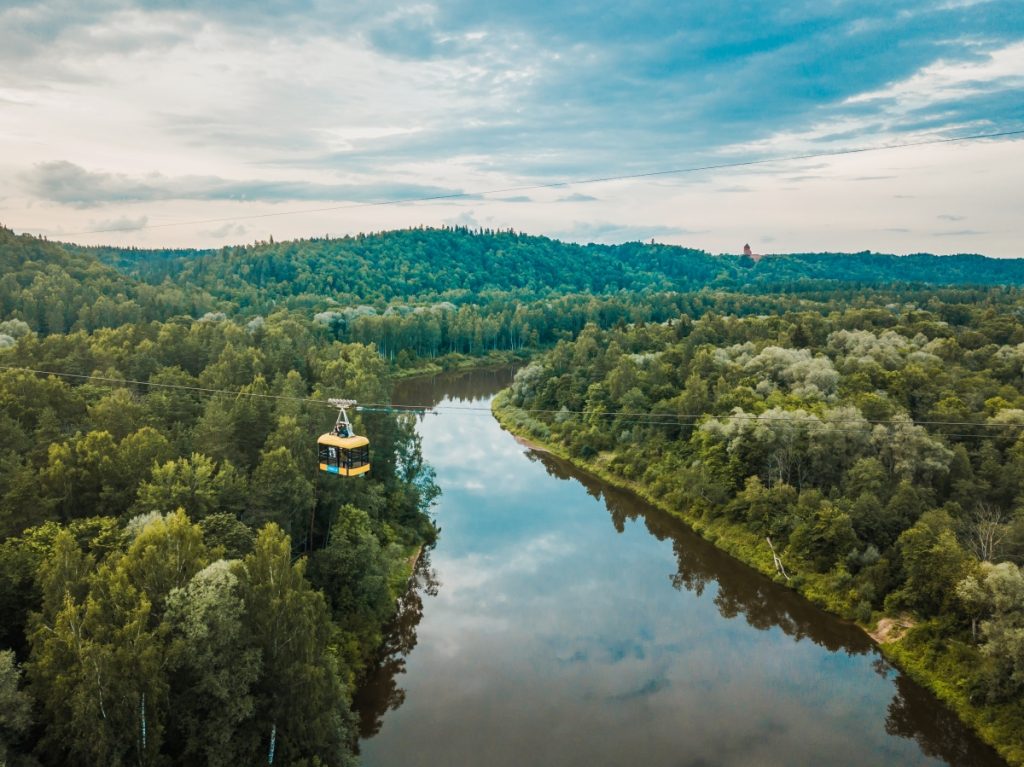
Sigulda cable car — 43 m above the Gauja valley
Step #3: Tarzāns adventure park — active control at height
Treetop obstacle courses reaching up to 20 meters, with 11 tracks of varying difficulty. This time you're actively controlling your body at height — important because acrophobia is often linked to a sense of losing control. Swiss-made Kanopeo continuous safety system keeps you attached throughout. Price: from €22. Address: Peldu iela 1, Sigulda. tarzans.lv
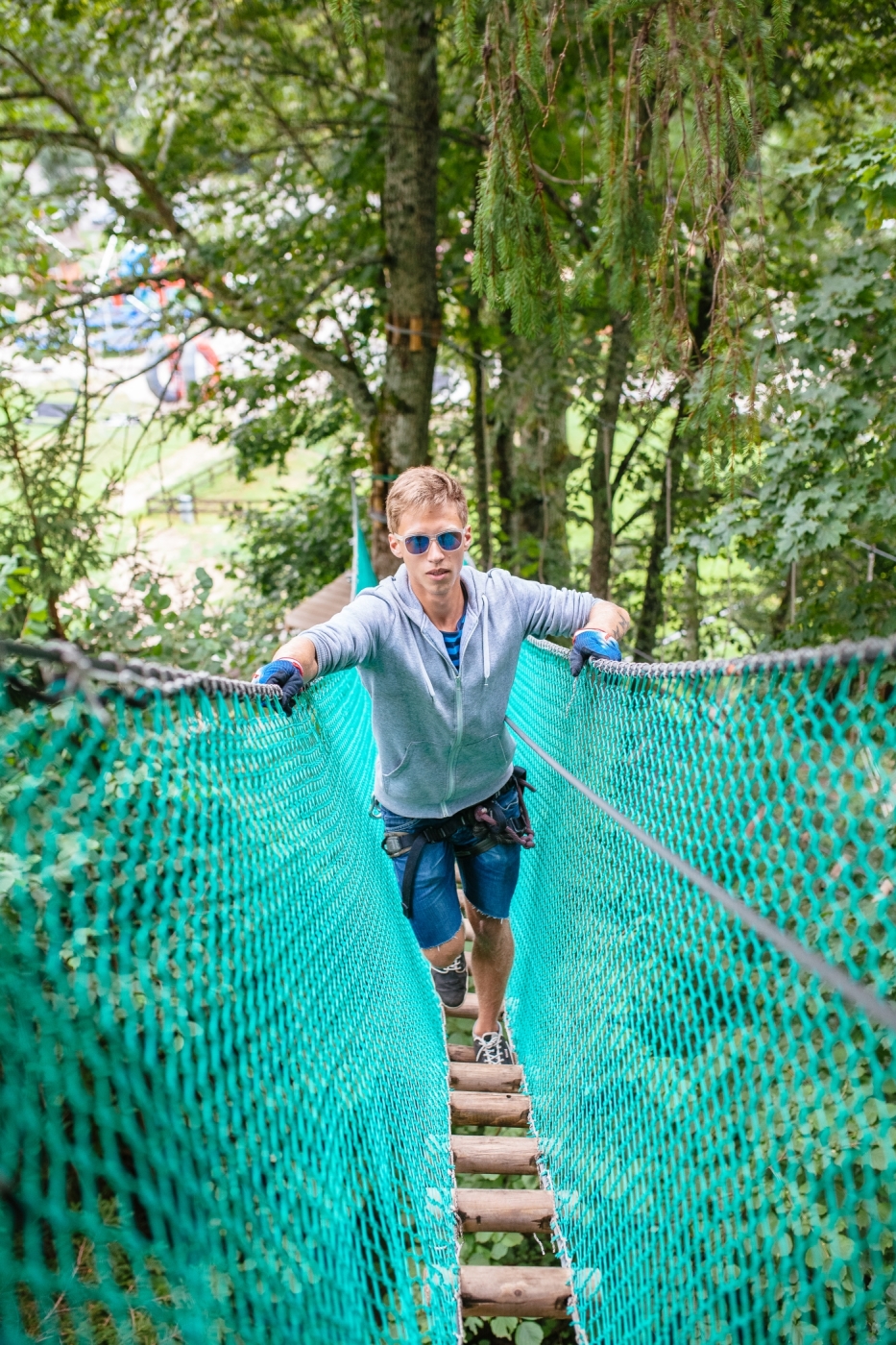
Tarzāns adventure park — active control at height
Step #4: Aerodium wind tunnel — repeat the freefall sensation
Aerodium is the first vertical wind tunnel in Eastern Europe. It lets you repeat the freefall sensation without an aircraft — reinforcing the positive memory from your skydive. Ideal for those who want to repeatedly train their body's response to the feeling of falling. Price: from €59/person. Location: Riga–Vidzeme highway, 47th km. aerodium
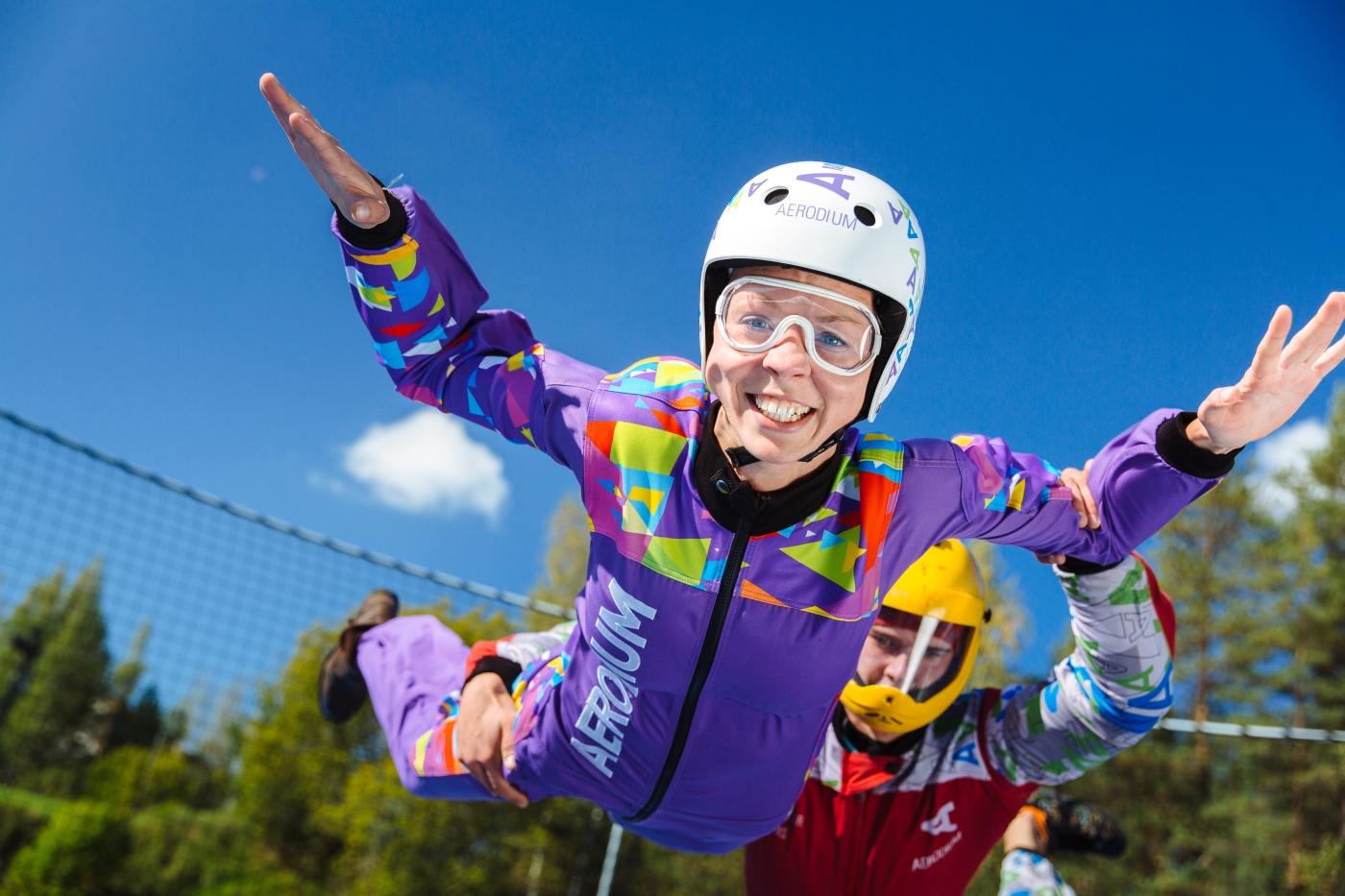
Aerodium wind tunnel near Sigulda — flying in an air stream
See our full guide to adventure activities in Latvia for more options.
Method comparison — which is right for you?
Skydiving stands out as the only method that doesn't trigger typical height fear while providing full professional accompaniment.
| Method | Triggers acrophobia? | Accompaniment | Cost | Best for |
|---|---|---|---|---|
| Tandem skydive | No (no depth cues) | 100% — harnessed to instructor | €239 | Step #1; recalibrates height perception |
| Cable car | Yes, mildly | Shared cabin | ~€14 | #2 — everyday height test |
| Tarzāns obstacle park | Yes, intensely | Safety line, but solo | from €22 | #3 — active control at height |
| Aerodium wind tunnel | No (low altitude) | Instructor nearby | from €59 | #4 — repeat freefall sensation |
| CBT therapy | Controlled | Professional therapist | €50–100/session | Severe cases, long-term |
| VR exposure | Simulated | Can be self-guided | €30–80/session | When real height still feels too overwhelming |
Over 3,000 people have already jumped with Skydive Latvia. Many admit they feared heights before the jump. The airfield is ~1 hour from Riga (Limbažu airfield). Reserve your jump →
Frequently asked questions
Why is there no fear at 4,000m but panic on a balcony?
Acrophobia is triggered by visual depth cues — the brain compares your position to the visible ground. At 4,000m these cues don't function — the landscape looks flat and the brain doesn't activate fear. A balcony at 15–30m is in the ideal range to trigger acrophobia.
Can acrophobia be completely cured?
Yes. CBT and exposure therapy show 90–95% effectiveness. For most people, fear diminishes to a manageable level within 8–12 sessions (Carl et al., 2019).
Does freefall feel like falling?
No. After exiting the aircraft, you reach terminal velocity (~200 km/h) within seconds. From that point there's no sensation of acceleration — the body feels steady air resistance, similar to a wind tunnel.
Can teenagers skydive?
Minimum age for a tandem jump is 16 years with parental consent (18 independently). Weight limit: up to 105 kg.
How safe is skydiving?
Tandem skydiving is one of the safest extreme activities. Skydive Latvia instructors (25+ years experience, 3,000+ jumps) use a Pilatus Porter PC-6/B2-H4 aircraft and USPA-standard equipment.
Does alcohol help with fear?
No. Alcohol temporarily reduces anxiety but reinforces phobia long-term. Skydiving and most adventure activities prohibit participation under the influence.
Do gift cards have an expiration date?
No. Skydive Latvia gift cards have no expiration date. The recipient chooses their own time. Available from €30.
What's the recommended sequence?
(1) Tandem skydive (recalibration) → (2) Sigulda cable car (test) → (3) Tarzāns (active control) → (4) Aerodium (reinforcement). This sequence works because the first step doesn't trigger acrophobia, but reprograms the brain's response.
Where can I read more about the scientific evidence?
Gibson & Walk (1960) visual cliff experiment: Wikipedia. VR exposure meta-analysis: PMC/JAMA. Exposure therapy effectiveness: Nature Scientific Reports.
