

Last updated: April 23, 2026
In short:
- Līgo Night is Latvia's summer solstice festival — the shortest night of the year, from June 23 to 24, celebrated with flower wreaths, bonfires, songs, and ancient rituals.
- Classic activities: weaving wreaths, decorating the yard with oak and birch, lighting the Jāņi bonfire, singing until dawn, leaping over the fire, searching for the mythical fern flower, greeting the sunrise.
- Public celebrations in 2026: Turaida Museum Reserve (June 21), Latvian Ethnographic Open-Air Museum, Dzegužkalns and Grīziņkalns parks in Riga, Herb Market on Dome Square.
- Jāņi is a 3–4 day holiday: on June 23 and 24 the Skydive Latvia airfield is closed — we respect the tradition, the festival belongs to the bonfire and the song. But the surrounding holiday days (June 20–22 before Līgo and June 25–26 after Jāņi) are among the most popular skydiving days of the whole season.
Līgo Night is the one night a year when Latvia pauses. Everyday life falls away, people gather in nature, and the air fills with something you don't find on any other evening — bonfire smoke, wild herbs, an old song drifting over the meadow. But what exactly should you do on this night to make it a real celebration rather than just another party? This guide walks through the practical pieces: preparation, rituals, public events in Latvia for 2026, and modern ways to enrich the long Jāņi weekend.
- How do you prepare for Līgo night?
- What songs and dances make Līgo night come alive?
- How do people search for the fern flower today?
- What Jāņi beliefs and rituals are still observed?
- Where can you celebrate Līgo publicly in Riga and Latvia?
- Traditional vs. modern Jāņi activities: a comparison
- How can you enrich the Jāņi holiday with something unforgettable?
- Frequently asked questions
How do you prepare for Līgo night?
Short answer: Preparation begins in the afternoon — weaving wreaths (wildflowers for women, oak leaves for men), decorating the yard with birch and oak branches, making Jāņi cheese, stocking beer, and clearing a safe spot for the bonfire. These three elements — wreath, fire, and the festive table — form the heart of the evening.
Wreath-weaving is more than decoration. Each plant carries meaning: clover brings luck, nettles ward off evil, vetch stands for love, and oak leaves represent strength and health. If it's your first time, start with a base of pliable branches and then weave in the flowers one by one — the wreath will hold together better and survive the full night.
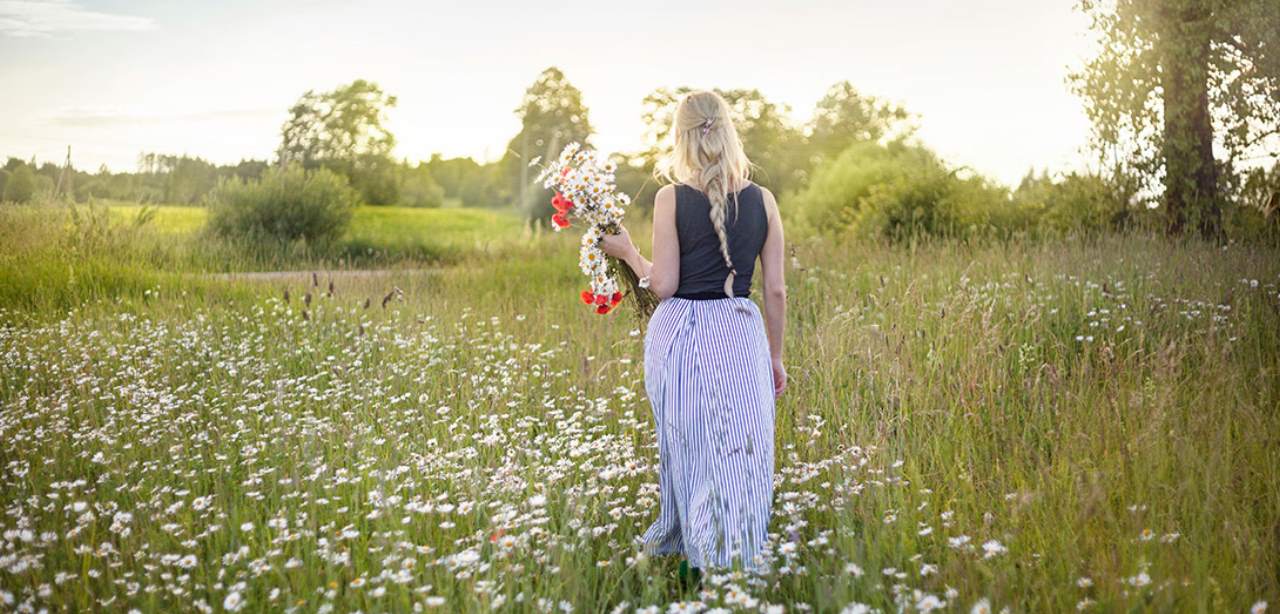
Decorating the house with birch and oak branches is more than aesthetic. According to latvia.travel, homes were traditionally also adorned with rowan branches, ferns, oxeye daisies, and bents, with nettles and thistles fastened to the door frame to keep evil spirits away. The custom survives not only in the countryside but in many Riga households, where at least a birch and an oak-leaf wreath will hang above the door on the eve of the solstice.
For the bonfire, choose an open, safe spot — well away from trees, buildings, and dry grass. Make sure water or sand is within reach in case of emergency. The fire needs to burn for hours, so stock plenty of wood to keep it alive all the way to sunrise.
Key preparation steps:
- Gather herbs and flowers for the wreaths (clover, nettles, vetch, rowan, oak leaves)
- Pick a safe bonfire site with water or sand within reach
- Decorate the house with birch and oak branches
- Prepare Jāņi cheese, beer, pies, and bread rolls
- Pack for a long night — a warm shawl, comfortable shoes, a rain jacket just in case
Practical tip: If you're heading to a public event, you can weave the wreath on-site — the Herb Market on Dome Square runs wreath-weaving workshops each year, and experienced artisans will help you make one from scratch.
See: what else to do in Latvia →
What songs and dances make Līgo night come alive?
Short answer: Latvian folk tradition calls for singing all night — the singing keeps everyone awake and holds the energy of the festival together. The Dainas archive contains more than 40,000 Līgo songs. Start with the most recognizable melodies, circle the fire in a dance, and — if you can — invite someone with a guitar, a fiddle, or a kokle.
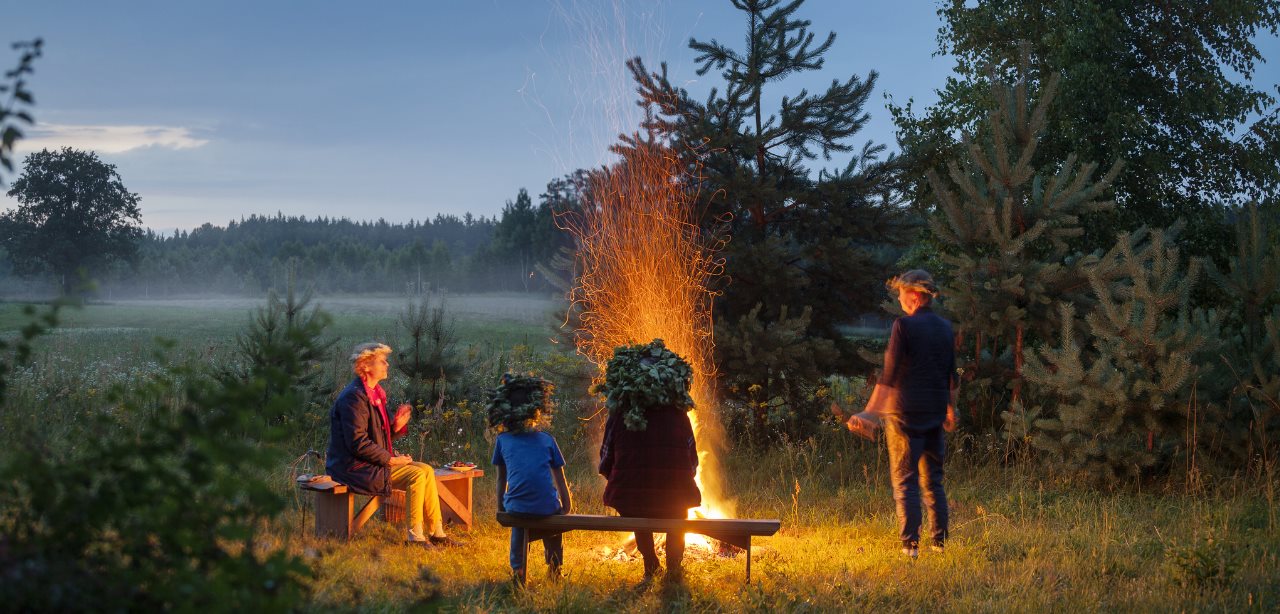
Before the evening, put together a small song list. If not everyone in the family or group knows the traditional songs by heart, the online Dainu skapis archive (dainuskapis.lv) or the Latvian Radio Folklore Archive are good sources — both have authentic Līgo songs with lyrics. Many are extremely simple, built around the repeated refrain "Līgo!" that anyone can pick up in minutes.
Dancing around the fire is both playful and symbolic. The circular motion echoes the sun's path, and the direction traditionally switches back and forth several times during the night. The number of people doesn't matter — even three figures moving around a small fire form an authentic Jāņi circle.
How to get the singing started:
- Begin with the most familiar melodies so everyone can join in
- Memorize at least two or three songs yourself
- Ask a friend to bring a guitar, accordion, or kokle
- When dancing around the fire, keep a safe distance from the flames
- If your home gathering is quiet, join a folklore group at a public event (see below)
For the night to come alive, three things are enough: fire, a song, and a good friend beside you.
If the home gathering isn't taking off — too few guests, not enough voices — it's easy to join a bigger public celebration. Delfi's festival guide compiles the largest Jāņi events across Latvia each year.
How do people search for the fern flower today?
Short answer: The fern flower hunt is a symbolic search for luck and fortune carried out in the forest on Jāņi night. Today it often turns into a group adventure: a torchlit walk, folklore-themed orienteering, or a geocaching trail. Ferns don't actually flower — that's the point. The mystery is the whole magic of the tradition.
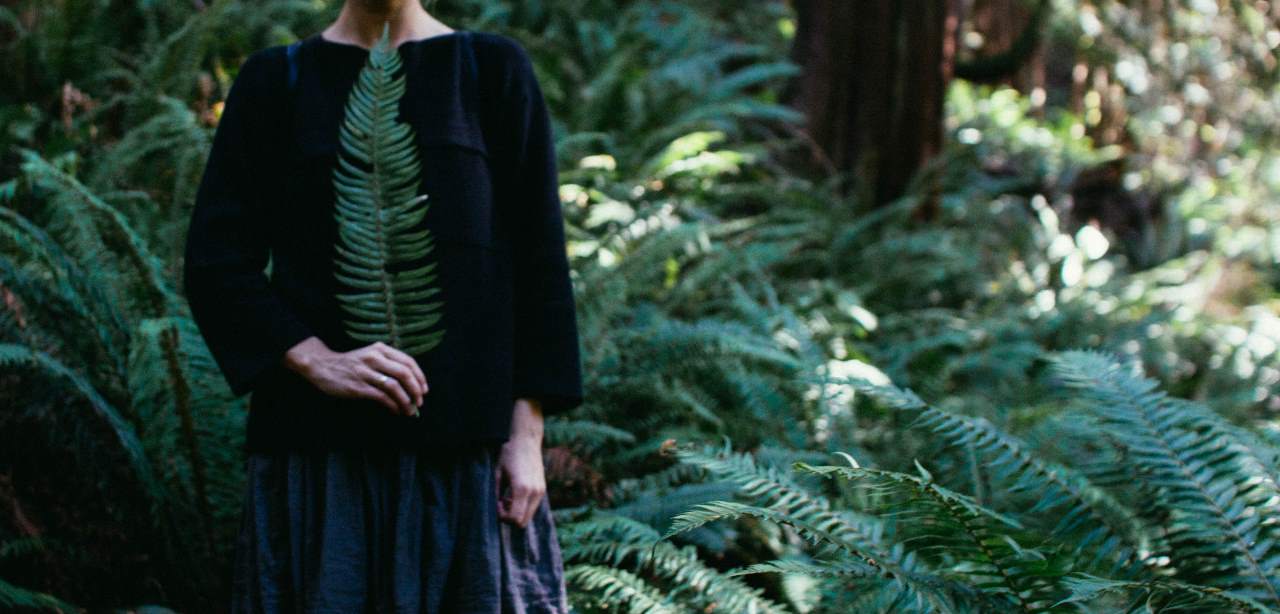
In modern form, the fern flower hunt fits beautifully into a wider nature experience. An orienteering game combines teamwork, the atmosphere of a dark forest, and physical movement. Geocaching — using GPS to find hidden caches — is a nice variation for groups who want to add a technological twist to the ancient ritual.
| Activity | Difficulty | Suitable age | Time needed |
|---|---|---|---|
| Torchlit forest walk | Medium | 14+ | 1–2 hours |
| Orienteering with folklore clues | Low | All ages | 30–60 min |
| Nighttime geocaching | High | 16+ | 2 hours |
| Photo-hunt in the forest | Low | All ages | 1 hour |
Safety reminder: Forest walks on Jāņi night happen in full darkness. Always bring a torch with spare batteries, never go alone, and agree on a meeting point with the group beforehand. Wear sturdy shoes — tree roots and uneven ground are everywhere.
For more ideas on nighttime adventures, see our article on active leisure ideas in Riga for adventure seekers.
What Jāņi beliefs and rituals are still observed?
Short answer: Many ancient Jāņi rituals are still practiced: leaping over the bonfire to shed burdens, washing your face in the morning dew for beauty and health, staying awake to greet the sunrise. These aren't just symbolic gestures — they're ways to step out of daily life and feel the fullness of the celebration.
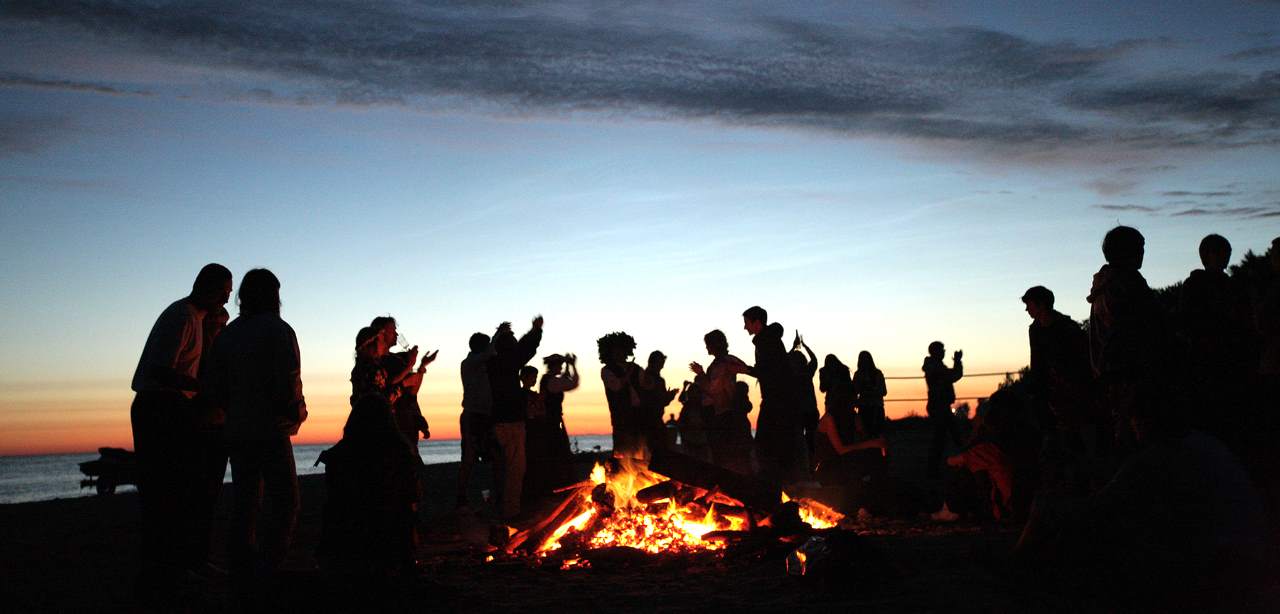
The most popular Jāņi beliefs and rituals:
- Leap over the bonfire — to shed burdens and protect against illness. Couples leap holding hands, so the magic of the flames binds them together.
- Wash in the morning dew — tradition says dew gathered at sunrise on Jāņi morning grants beauty and health for the year ahead.
- Greet the sunrise — anyone who falls asleep on Jāņi night "will sleep all summer," according to the old belief. Sunrise in Latvia in late June is around 4:30 a.m., and it's the climax of the night.
- Float a wreath on water — for unmarried women, the direction the wreath drifts hints at where a future partner will come from.
- The pre-Jāņi sauna — before heading to the fire, it was traditional to cleanse in the pirts with a besom of Jāņi herbs. This ritual is still a centerpiece of Latvian sauna culture.
Safety tip: If you plan to leap the bonfire, wait until the flames have settled down to glowing coals. It's both safer and more authentic — historically, the leap was done over the ember stage rather than the high flame. Children should never leap without adult supervision.
If you want to combine tradition with a nature adventure, the forests and rivers of Vidzeme are an ideal setting for an authentic celebration — more ideas in our guide to active leisure in Vidzeme.
Where can you celebrate Līgo publicly in Riga and Latvia?
Short answer: If you don't have a countryside option, Latvia has several well-established public Jāņi events: Turaida Museum Reserve on Jāņkalns hill (June 21), the Latvian Ethnographic Open-Air Museum Diždiena "Līgo. Ziedēšana", and in Riga the Dzegužkalns and Grīziņkalns parks (night of June 23–24), plus the Herb Market on Dome Square on June 20.
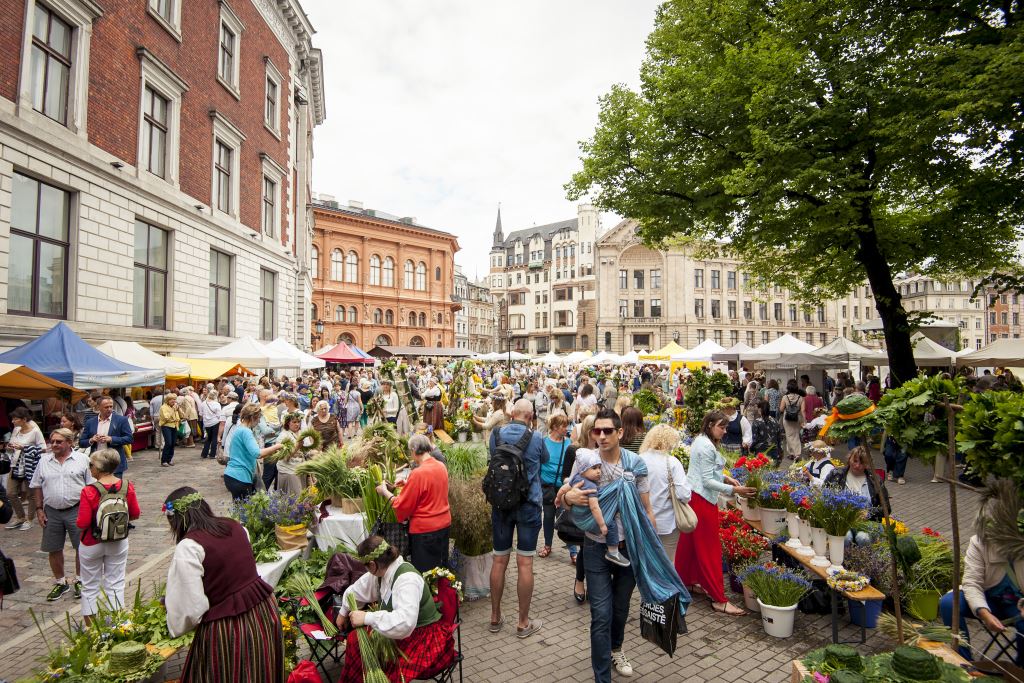
Public events are a good choice if you live in the city, don't have a family homestead, or simply want to see how Jāņi is celebrated by a larger crowd. Here are the main 2026 events that repeat in a similar format every year:
Turaida Museum Reserve — Jāņkalns hill
When: June 21, from 4:00 a.m. to midnight.
What happens: for the eleventh year running, Jāņkalns hosts a full solstice program — yard blessings, wreath weaving, cheese making, torch preparation, the honoring of Jāņu Father and Jāņu Mother, the fire ritual, and a grand folklore-group singing until sunrise.
Best for: those who want a deeply ritualized, authentic Jāņi experience in a heritage landscape.
More: turaida-muzejs.lv
Latvian Ethnographic Open-Air Museum — Diždiena "Līgo. Ziedēšana"
When: June 21, all day.
What happens: folk-dance ensembles, folklore groups, and kokle players; hands-on workshops in wreath weaving, cheese making, and pie baking; a large-scale folk-dance stage performance.
Best for: families and those who want to explore traditional crafts in one place.
More: brivdabasmuzejs.lv
Dzegužkalns, Riga — Traditional Jāņi
When: evening of June 23 into the morning of June 24.
What happens: opening ceremony with Jāņu Father and Mother, blessings with the ethno group "Zeidi", the Jāņi fire-lighting ritual, a concert by the band "Iļģi", dancing with the Rīgas Danču Klubs, and greeting the sunrise with "Jauno Jāņu Orķestris".
Best for: those wanting an authentic public Jāņi without leaving the city.
Grīziņkalns Park — "From sun to sun"
When: June 23, 8:00 p.m. until June 24, 4:30 a.m.
What happens: folklore and post-folk bands, bonfire lighting, DJ and drumming sets, a sunrise gathering.
Best for: those who want a higher-energy, more modern Jāņi in a city park.
Herb Market on Dome Square
When: June 20, 9:00 a.m. to 7:00 p.m. (pre-festival).
What happens: Jāņi herbs, wreaths, homegrown produce, artisan goods, and a stage program of folk dance and singing.
Best for: anyone preparing for the holiday who wants to pick up traditional items in one place.
For more ideas on what to do in Riga beyond Jāņi night, see our article on adrenaline activities in Riga.
Traditional vs. modern Jāņi activities: a comparison
How to choose what to do? Traditional and modern activities aren't opposites — they complement each other well. The table below helps you weigh the options for your own Jāņi plan.
| Activity | Atmosphere | Price | Best for |
|---|---|---|---|
| Home Jāņi with a bonfire | Traditional, calm | Free (+ wood, food) | Families, close groups |
| Turaida Museum Reserve | Ritual-rich, heritage | From €10 / person | Tradition lovers |
| Dzegužkalns / Grīziņkalns, Riga | Public, concert-style | Free or low cost | City dwellers, younger crowds |
| Night hike / orienteering | Adventurous | Low (self-organized) | Active groups |
| Tandem skydive before/after the festival | Adrenaline | From €249 | Adventure seekers |
| Pre-Jāņi sauna session | Relaxation | From €30 / person | Wellness lovers |
How can you enrich the Jāņi holiday with something unforgettable?
Short answer: Jāņi in Latvia isn't a single night — it's a 3–4 day holiday. The Skydive Latvia airfield is closed on Līgo Day (June 23) and Jāņi Day (June 24) itself — we respect the tradition. But the surrounding holiday days — June 20, 21, 22 before the festival and June 25, 26 after — are among the most popular jump dates of the whole season. A tandem skydive runs about 60 seconds of freefall from 4,000 m at Limbaži Airfield, an hour's drive from Riga.
Why does this option fit the Jāņi weekend specifically? In 2026, Līgo Day falls on a Tuesday and Jāņi Day on a Wednesday — combined with adjacent weekends and the common practice of taking Monday or Thursday/Friday off, this stretches into a five-to-seven-day break for many Latvians. Līgo night itself and Jāņi morning belong to the bonfire, the song, and family — and the Skydive Latvia airfield is closed on exactly those two days, out of respect for the tradition. But the surrounding days — the Sunday before Līgo, the Monday, the Thursday and Friday after Jāņi — are among the most-booked jump dates of the entire season.
From 4,000 meters, all of Latvia opens up in one view — the lakes around Limbaži, the forests of Vidzeme, the Gulf of Riga in the distance. Freefall reaches about 200 km/h, and this is one of those rare moments when you can completely forget the earth exists. No preparation is needed — the instructor clips into you, the pilot takes you up, and your only job is to relax and enjoy. The full jump is €249, with a €30 reservation paid online and the balance payable at the airfield.

For those who want more, Oxygen Jump is the highest civilian tandem jump in Eastern Europe — from 5,500 meters, with supplemental oxygen masks, aboard a Pilatus Porter PC-6 aircraft. Freefall lasts around 90 seconds and tops out at 220 km/h. That's an extra 30 seconds of freedom compared to the standard tandem — and from that altitude the view isn't just Latvia but the Baltic Sea, with the southern coast of Estonia visible on a clear day. Price €490.

Here's a short video that walks through a tandem jump from first-person view — from the briefing to the landing at Limbaži Airfield:
If this idea surprises a friend, relative, or colleague as a gift — Skydive Latvia gift cards have no expiration date and can be redeemed in any season. And the shared experience itself is exactly what Līgo is about — the kind of togetherness that binds a group tighter than any song ever could.
Frequently asked questions
Do you always need a bonfire on Līgo night?
A bonfire is one of the central Līgo symbols, but you can celebrate without it — in a Riga apartment, on a restaurant terrace, or on a city balcony. What matters most is company, song, and staying up through the night. If you live in the city and want the fire, Dzegužkalns and Grīziņkalns parks both light public bonfires open to everyone.
How popular is the fern flower search today?
The fern flower search is more symbolic than literal — ferns don't actually produce flowers, so nobody will ever find one. But the process (a night hike, orienteering, shared adventure in the dark) has become a beloved Jāņi-night activity, especially for couples and friend groups.
What should you do on Līgo night if it rains?
Latvians say "it's raining as if it were Jāņi" — rain on this night is so common it's already a joke before the celebrations begin. Move under an awning, set up a tent, open a shed, or stay indoors with the windows open so the bonfire smoke and songs can still reach you. Rain isn't an obstacle; it's part of the authenticity.
What safety rules apply to bonfire rituals?
Build the fire in a safe spot — far from trees, buildings, and dry grass — with water or sand within reach. Only adults should leap the fire, and only once the flames have dropped to coals. Children should never leap without supervision, and alcohol slows reaction time, so it's best not to combine drinking with the jump.
What modern activities pair well with Līgo night?
Traditions blend well with night orienteering, geocaching, a photo hunt with a tripod, a pre-bonfire sauna session, or — on the daytime hours of the Jāņi weekend — an active adventure like a tandem skydive. The guiding principle: an activity shouldn't pull you away from the heart of the festival — togetherness, song, and the night spent awake.
What time is sunrise on Jāņi night?
In late June in Latvia, sunrise falls around 4:30 a.m. — the night from June 23 to 24 is the shortest of the year. If you plan to greet the sunrise, don't lie down after midnight: movement, singing, and warm tea help push through the final hours. Watching sunrise from an open place (a hilltop, a meadow, the coast) is one of the most beautiful Jāņi morning rituals.
Is it safe to swim in a lake or river on Jāņi night?
Tradition not only allows but encourages swimming — sometimes naked — on Jāņi night, with the belief that the water carries special strength. But the practical reality is that night swimming in open water takes caution: never swim alone, under the influence of alcohol, in an unfamiliar place, or where you can't see the bottom. Pick a shallow, known spot and go in pairs or as a group.
How far from Riga is Turaida Museum Reserve for Jāņi?
Turaida Museum Reserve is about 50 km from Riga — a 30 to 45 minute drive along the Vidzeme highway toward Sigulda. The June 21 program starts at 4:00 a.m. and runs until midnight, so many visitors choose to stay overnight in Sigulda or a nearby guest house.
Do Skydive Latvia jumps happen during the Jāņi holiday?
On Līgo Day itself (June 23) and Jāņi Day (June 24) the Skydive Latvia airfield is closed — we respect the tradition, and the team celebrates with family. However, the surrounding holiday days — the Saturday and Sunday before Līgo, plus the Thursday and Friday after Jāņi — are among the most popular jump dates of the entire season, since many Latvians extend the holiday into a longer break. Slots fill quickly, so early booking is recommended. Full info on the tandem jump page.

Recommended
- 7 iedvesmojošas idejas aktīvai atpūtai Rīgā piedzīvojumu meklētājiem – Skydive Latvia
- 6 idejas, ko darīt Saulkrastos aktīviem piedzīvojumu meklētājiem – Skydive Latvia
- Ko darīt Rīgā — 7 adrenalīna aktivitātes 2026 – Skydive Latvia
- Ko darīt Siguldā – Piedzīvojumu un aktivitāšu iespējas – Skydive Latvia