

Last updated: July 11, 2026
A bungee jump in Sigulda, Latvia, costs from €99 and delivers its full adrenaline hit in 2–3 seconds of freefall from 43 metres. A tandem skydive with Skydive Latvia at Limbaži airfield, about an hour from Riga, costs €249 and gives roughly 60 seconds of freefall from 4,000 m at ~200 km/h. One is a lightning strike, the other a long storm — here is how to choose.
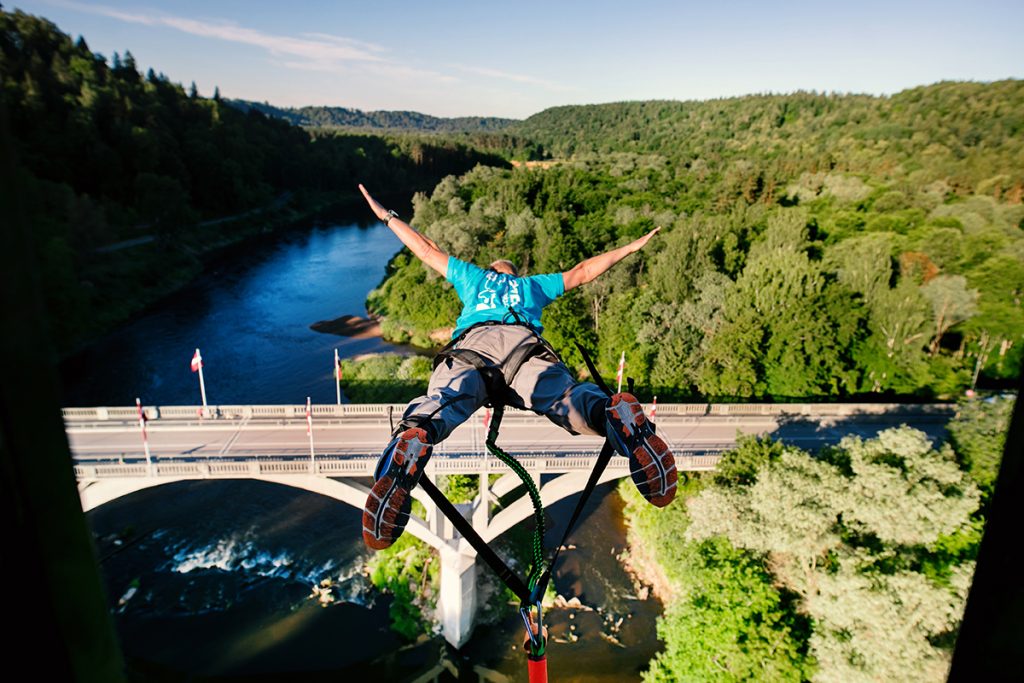
Bungee jumping from the Sigulda cable car — 43 metres above the Gauja valley
How does adrenaline work in a bungee jump vs a skydive?
The hormone is identical; the profile is not. In a bungee jump the spike is instant — your body gets the full dose within the first 2–3 seconds of the fall, before the mind has processed what is happening. In a skydive, adrenaline starts climbing in the plane, peaks during ~60 seconds of freefall and then settles into a calm euphoria under the canopy.
Physiologically both trigger the same chain: the adrenal glands release adrenaline, the heart rate jumps, pupils widen, muscles get more oxygen. The difference is time. A bungee jump is over before you can think; a skydive gives you whole minutes, which is why people remember it in far more detail.
Psychologically, both train you to face fear, but longer-lasting experiences give the mind more time to learn to work under pressure — a point the Latvian lifestyle magazine Habitus makes in its piece on adrenalīna aktivitātes (adrenaline activities) and why driven people choose them deliberately.
How does a bungee jump create the sharpest adrenaline burst?
Latvia's bungee jumping happens at Bungee Sigulda — a jump from the famous cable car 43 metres above the Gauja river, and the only place in Northern Europe where you jump straight from a moving cable car cabin. A solo jump costs €99, a tandem jump for two is €149, and a jump video is €19. The season runs from spring to autumn.
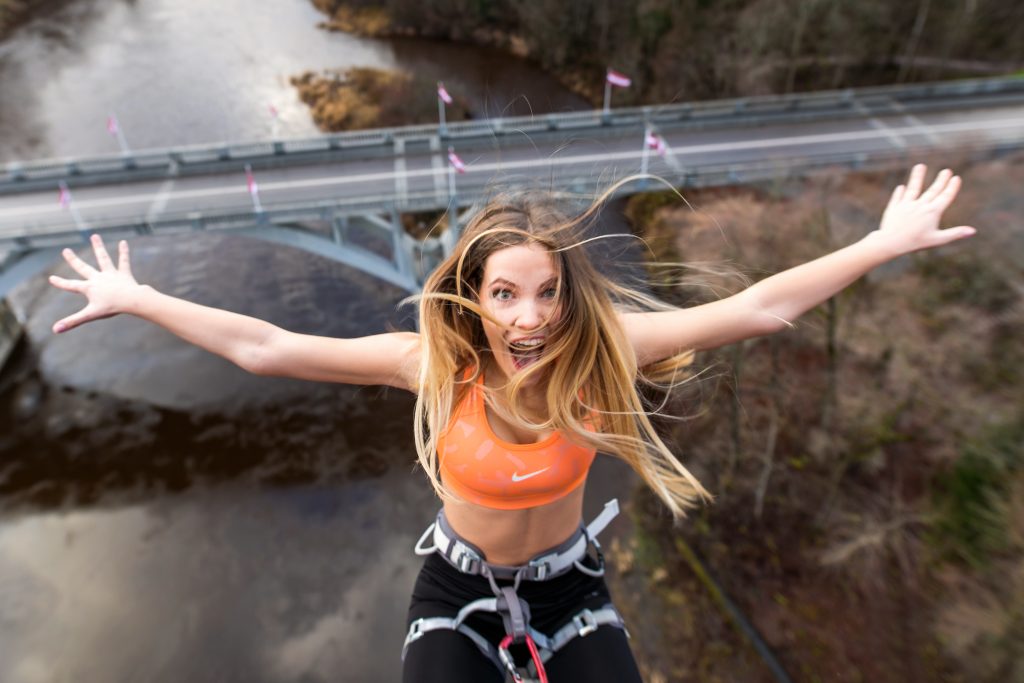
A couple of seconds of freefall before the cord gently catches the jumper above the Gauja
The operator's track record is serious: more than 150,000 people have jumped from the Sigulda cable car since 1992, and since 1998 the LGK group has run an expert-approved safety programme with a 7–20× strength reserve in every system. The weight range is wide — 35 to 200 kg — and jumps go ahead even in rain; only storms and strong wind stop the cable car.
On the world's tallest platforms freefall speeds in bungee can exceed 100 km/h — our Latvian overview of extreme sports covers this in the section on bungee freefall speed. From 43 metres in Sigulda the fall is shorter, but the jolt of acceleration feels just as sharp: your stomach lifts, your breath stops for a moment, and then the cord takes over.
Preparation is minimal — a short briefing and a gear check, as we describe in our guide to adrenaline days out near Riga — which makes bungee the fastest adrenaline fix in Latvia. For a deeper look at how a first jump works, see our bungee jumping guide.
Pro tip: jumpers in the cabin go in order of weight category, and the whole activity can take up to an hour — leave time in your plan.
How does skydiving deliver adrenaline that lasts minutes?
A tandem skydive with Skydive Latvia starts at 4,000 m: roughly 60 seconds of freefall at about 200 km/h, followed by 4–6 minutes under the canopy above the Vidzeme countryside. The price is €249, with a €30 online reservation and the balance paid at the airfield. Photos and video are an optional add-on at €89.
The adrenaline arc has three phases. First, the climb: the Pilatus Porter PC-6 takes 15–20 minutes to reach altitude, and the anticipation is psychologically the strongest part. Second, freefall: the first seconds after exit are a blur, then your body finds the airflow and everything turns into pure, focused presence. Third, the canopy ride: the adrenaline does not vanish — it turns into a calm euphoria with views stretching to the sea on a clear day.
For first-timers the safest route is a tandem jump with an experienced instructor who handles everything technical. And if 4,000 m is not enough, the Oxygen Jump from 5,500 m with supplemental oxygen gives around 90 seconds of freefall for €490 — the highest civilian tandem jump in Eastern Europe.
Surveys of adrenaline-sport participants regularly find that well over two thirds report better stress resilience after taking part regularly — exact figures vary by source, but the trend is consistent: a long adrenaline experience trains the mind, not just the emotions.

Tandem skydive from 4,000 m — about 60 seconds of freefall at ~200 km/h
Pro tip: focus on breathing during freefall — a deep exhale in the first seconds helps your body process the adrenaline surge so you can actually enjoy the fall rather than just endure it.
Bungee jump vs skydiving: side-by-side comparison
Both experiences are safe with certified professionals and both welcome complete beginners. The real differences are duration, altitude, price and what the experience leaves behind. There is no universal right answer — adrenaline activities should match your personal risk appetite and experience — so compare the facts.
| Criterion | Bungee jump (Sigulda) | Tandem skydive (Skydive Latvia) |
|---|---|---|
| Height | 43 m above the Gauja | 4,000 m (Oxygen Jump — 5,500 m) |
| Price | €99 solo / €149 tandem | €249 (Oxygen Jump — €490) |
| Freefall | 2–3 seconds | ~60 seconds (~90 s Oxygen Jump) |
| Total experience | A few minutes with rebounds | 5–7 minutes in the air plus the plane ride |
| Season | Spring to autumn | April–October |
| Weight / age | 35–200 kg; under-18s with a parent present | Up to 105 kg (max 205 cm); from age 16 with parental consent |
| Emotional character | Instant shock and euphoria | Gradual build-up and lasting presence |
On safety, both operators work on the principle of redundant systems: Bungee Sigulda uses mountaineering-grade equipment with a multiple strength reserve, while Skydive Latvia's safety standards mean certified tandem gear with a reserve parachute and instructors with thousands of jumps.
If you are thinking about this as a present, one practical detail matters: Skydive Latvia gift cards have no expiration date — the recipient can wait for perfect weather or even the next season without losing the gift's value.
Which one should you try first?
If you want maximum intensity in minimum time, start with the bungee jump in Sigulda — it is 50 minutes from Riga and evening jumps run even on weekdays. If you want an experience that lasts, changes how you handle fear and becomes a story rather than a moment, choose the tandem skydive.
- A quick adrenaline fix after work: bungee — short briefing, one jump, done within the hour.
- An adventure you plan as an event: tandem skydive — half a day at Limbaži airfield with the flight, the freefall and the canopy ride.
- You want to become a licensed skydiver: only skydiving offers a path onward, through AFF training.
- You are choosing a gift: both come as gift cards; the skydiving one never expires.
When 43 metres is no longer enough: jumping from 4,000 metres
Many adrenaline seekers in Latvia follow exactly this path: first the bungee in Sigulda, then a tandem skydive in Limbaži. The logic is simple — if 2–3 seconds of freefall lit you up, 60 seconds from 4,000 m is the next level: twice the speed, views stretching for dozens of kilometres, and an experience long enough to savour consciously rather than just survive.

Oxygen Jump from 5,500 m — around 90 seconds of freefall with supplemental oxygen
Skydive Latvia operates from Limbaži airfield, about an hour's drive from Riga, from April to October. If the first tandem leaves you wanting more, AFF training is the structured route to a solo licence — Skydive Latvia is the only USPA- and FAI-certified AFF training centre in the Baltics. For the wider picture, browse our guide to adventure activities in Latvia.
This video shows what a tandem jump looks like from the jumper's perspective — from boarding the plane to landing:
FAQ
Which adrenaline hit is stronger — bungee or skydiving?
The bungee jump gives a sharper instant jolt, because everything happens in 2–3 seconds with no time to prepare. Skydiving releases more adrenaline overall, because the experience lasts minutes: the climb in the plane, ~60 seconds of freefall and the canopy ride. In short — bungee is sharper, skydiving is deeper.
How much do bungee jumping and skydiving cost in Latvia?
A bungee jump in Sigulda costs €99 solo or €149 for a tandem jump for two. A tandem skydive with Skydive Latvia costs €249 from 4,000 m, and the Oxygen Jump from 5,500 m costs €490. A photo and video package for the skydive is available for €89.
Are both activities safe for beginners?
Yes. Bungee Sigulda has operated since 1992 with redundant safety systems and a 7–20× strength reserve. On a Skydive Latvia tandem the instructor handles the entire technical side, the equipment is certified with a reserve parachute, and a short briefing before the jump is all a beginner needs.
What are the weight and age limits?
For the Sigulda bungee your weight must be between 35 and 200 kg; if you are under 18, a parent signs the contract on site. For skydiving with Skydive Latvia the limit is 105 kg (height up to 205 cm), and you can jump from age 16 with written parental consent and a parent present; from 18 independently.
Do these experiences work as gifts?
Yes, both operators sell gift cards. Skydive Latvia gift cards start from €30 and have no expiration date — the recipient can pick the most convenient day or even wait for the next season without losing the gift. That is especially practical for winter gifting, when the jump season is closed.
