

Updated: May 25, 2026
Skydiving industry challenges in 2026 are more layered than they look from outside. The USPA 2025 fatality report records 16 deaths across approximately 3.47 million jumps — 0.46 per 100,000, above the decade average. Most incidents trace back to human factors rather than equipment failures, and that pattern points to where the industry still has work to do: training quality, safety culture, and accountability for decisions.

- What does the 2025 safety data actually show?
- Why do most incidents come down to human factors?
- Which market pressures shape the industry now?
- How much of safety depends on training and certification?
- How are technologies changing skydiving safety?
- How do different skydiving formats compare on safety?
- How does Skydive Latvia address these industry challenges?
- Frequently asked questions
What does the 2025 safety data actually show?
In 2025, the United States Parachute Association (USPA) recorded 16 fatalities out of roughly 3.47 million jumps — a rate of 0.46 per 100,000, or about one fatality per 217,000 skydives. That is above the decade average of about 12–13 fatalities per year, yet in absolute terms skydiving remains one of the safer extreme sports.
For context: BASE jumping recorded 29 fatalities in 2025 from a much smaller jump population, putting it roughly 100 times more dangerous per jump than skydiving. Scuba diving sits at approximately 0.45 fatalities per 100,000 dives — a nearly identical figure to skydiving. Driving, measured on a per-distance basis, is statistically more dangerous than a tandem jump.
What matters more than raw counts is the distribution of causes. USPA reports consistently show that around 90% of fatalities involve human factors rather than equipment failure. That tells the industry where the leverage is: safety culture, not just better gear.
Why do most incidents come down to human factors?
If the technology is so good, why do accidents happen at all? The answer is almost always the same: human decisions. 40% of 2025 fatalities occurred under a fully functional canopy — aggressive low turns or canopy-to-canopy collisions during the landing phase. The main parachute worked. The decision didn't.

Canopy piloting is a skill experienced jumpers often underrate. A last-second low-altitude turn loses altitude faster than the jumper expects, and reaction time is minimal. The statistics are stark: the majority of fatalities are not among first-time tandem passengers but among experienced licensed jumpers who overestimate their margins.
The cumulative effect of small decisions
Safety demands vigilance even after thousands of jumps. Accidents rarely come from one dramatic error — more often from a chain of seemingly minor decisions:
- Wind conditions right at the legal limit — technically allowed, with less margin for error
- A last-second turn at low altitude to refine the landing spot
- Landing in an area with obstacles the jumper "already knows"
- A training gap when a jumper returns after a long break without recurrency
- Group pressure nudging someone to jump despite doubts
Each choice on its own is small. Together they produce an accident. This is why safety culture inside the industry matters as much as equipment certification.
Which market pressures shape the industry now?
The business side of skydiving in 2026 faces several pressures at once. The experience economy is growing, but that doesn't make life easier for every operator. Competition is sharper, customer expectations are higher, and the regulatory environment is more complex.
Key market challenges:
- Demographic shifts. Younger customers expect not just a jump but a complete content experience with video and photos for social media. Operators must invest in cameras, photo/video staff, and content quality.
- Seasonality. Most northern European dropzones operate only part of the year. Latvia's season runs April through October, meaning annual revenue has to be earned in six months.
- Regulatory pressure. Civil aviation authorities worldwide are tightening requirements on instructor certification, equipment maintenance, and operations documentation. Each new requirement adds cost.
- Insurance costs. Following industry-level incidents, premiums rise across the sector — even for operators with flawless safety records.
- Qualified instructor shortage. Producing a certified tandem or AFF instructor takes years and substantial investment. In small markets like Latvia, the pool of available instructors is naturally limited.
- Off-season revenue smoothing. Operators who offer gift cards without expiry dates or winter training camps abroad can level revenue across the full year.
Differentiation is the survival factor. Operators offering only standard tandem jumps face heavy price pressure. Those who offer unique experiences — altitude records, specialised training programmes, or military training contracts — build steadier customer loyalty.
How much of safety depends on training and certification?
If you single out one factor that drives skydiving safety, it's training. The AFF student fatality rate is 0.15 per 100,000 jumps — lower than sport-jump fatalities (0.92 per 100,000). That looks counter-intuitive, but it tells a clear story: structured training with instructors in the air is safer than independent jumping without continuous refresh.
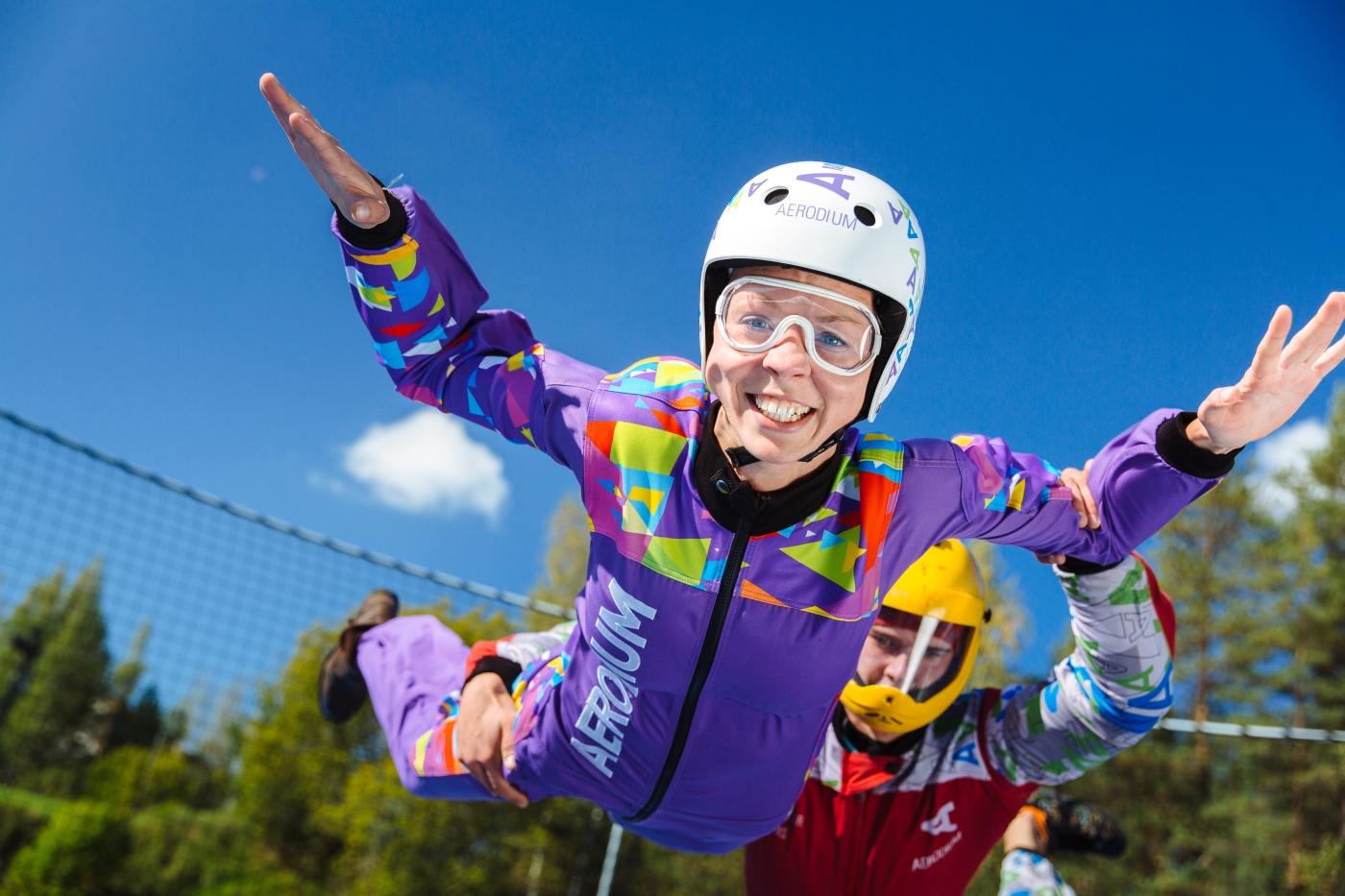
Wind tunnel training lets students lock in body stability before a real jump.
International certification programmes — USPA (United States Parachute Association) and FAI (Fédération Aéronautique Internationale) — are not just formal requirements. They guarantee that instructors are trained against unified standards and their knowledge is regularly verified. In Latvia, Skydive Latvia operates the only USPA and FAI certified AFF training centre in the Baltic states.
Training formats and their effectiveness
Different training formats contribute differently to safety:
- Tandem briefing (30–60 min) — for first-time jumpers; large safety margin because the instructor controls every critical decision
- AFF course (8 levels, several days) — entry to independent jumping; structured training with two instructors in the air during the early levels
- Recurrency training — at the start of each season, especially after a break; reduces "rust"
- Canopy piloting courses — for mid-level jumpers who have mastered freefall but want sharper landing accuracy
An instructor with a strong safety culture teaches more than procedures — they teach a mindset where saying "no" is just as acceptable as saying "yes." Over time, this is what produces safe dropzones.
How are technologies changing skydiving safety?
Modern skydiving equipment is a multi-layer safety system. Equipment failure is rarely fatal anymore — and that is the direct result of this layered design.

The Pilatus Porter PC-6 is one of the most respected jump aircraft in the world, with STOL capability and a wide safety margin even with engine issues.
Specific technological advances now defining the industry's safety baseline:
- Automatic Activation Devices (AAD). These electronic units deploy the reserve parachute automatically if the jumper falls past a set altitude too fast. They are now standard in professional skydiving.
- Reserve Static Line (RSL). A mechanical system that helps fire the reserve quickly after a cutaway.
- Modern fabrics and canopy designs. Today's parachutes are more predictable, more durable, and more precise than those of 20 years ago.
- Digital audible altimeters. Alert the jumper to critical altitudes by sound, reducing the risk of altitude loss in freefall.
- Digital tracking platforms. Operators digitally track equipment maintenance schedules, instructor certifications, and customer medical forms, cutting administrative error.
- Video analysis in AFF. Jump video lets instructors review student technique frame by frame and deliver targeted feedback.
Technology adoption challenges are real. Modern gear is expensive, and smaller operators can struggle to finance regular upgrades. There is also a new risk: over-reliance on automation can erode a jumper's personal accountability. In an emergency, the solution usually depends on the jumper's preparation — not on a device.
How do different skydiving formats compare on safety?
Safety figures vary significantly depending on the type of jump. This breakdown shows where the real risks concentrate.
| Jump type | Fatality rate | Main risk | Suitable for beginners |
|---|---|---|---|
| Tandem skydive | ~1 in 500,000 jumps | Rare — landing phase | Yes, ideal first jump |
| AFF student | ~0.15 per 100,000 jumps | Procedural compliance | Yes, with full training |
| Licensed sport jumper | ~0.92 per 100,000 jumps | Canopy collisions, aggressive turns | No — requires license |
| Night jumps | ~2.1 per 100,000 jumps | Visibility, orientation | No — experience required |
| BASE jumping | ~43 per 100,000 jumps | Proximity to obstacles, no time buffer | No — extreme threshold |
The pattern is clear: a tandem skydive — the standard first experience for most people — is around 280 times safer than BASE jumping and several times safer than a licensed solo sport jump. That's because a certified tandem instructor with thousands of jumps under their belt controls every critical decision.
How does Skydive Latvia address these industry challenges?
The industry challenges this article covers — human factors, training quality, equipment standards, seasonality — are addressed in Latvia by Skydive Latvia, which operates from Limbaži Airfield (about 1 hour north of Riga). On a practical level this shows up in several concrete ways: the only USPA and FAI certified AFF training centre in the Baltic states, instructors with 15–25 years of experience and 2,000–3,800 jumps each, a Pilatus Porter PC-6 with STOL capability and a real engine-out safety margin, doubled equipment checks before every jump, and honest go/no-go calls on weather rather than convenience.
Skydive Latvia offers two tandem formats that fit different experience seekers:

Tandem skydive from 4,000 m is €249 and includes about 60 seconds of freefall at speeds up to 200 km/h. This is the standard first jump — the safest way to experience skydiving. The optional photo/video package at €89 captures the freefall.
Oxygen Jump from 5,500 m is €490 and delivers around 90 seconds of freefall at up to 220 km/h. This is the highest civilian tandem jump in Eastern Europe, requiring supplemental oxygen on the climb to altitude. The price reflects the logistics of operating at record altitude.
To get a feel for what the operation actually looks like, this video shows a real tandem jump with the Skydive Latvia team:
For those who want to become independent skydivers, the full AFF course at €1,790 (theory from €40) is the only USPA/FAI certified programme in the Baltics and delivers an internationally recognised certificate for solo jumps.
Gift cards from €30 with no expiration date solve one of the industry's structural problems — seasonality. The recipient can choose a time that suits them, and there is no pressure to jump in unsuitable conditions.
Frequently asked questions
How often do parachutes fail?
Main parachute malfunctions occur roughly once every 750–1,000 jumps, but most are resolvable through standard emergency procedures and the reserve parachute. USPA 2025 data shows 4,777 reserve deployments — the system worked exactly as designed.
How safe is tandem skydiving compared with other extreme sports?
The tandem fatality rate is approximately 1 per 500,000 jumps — making it the safest form of skydiving for beginners and roughly 280 times safer than BASE jumping (~43 per 100,000). The numbers put it close to scuba diving in overall risk.
Why did fatalities rise in 2025?
USPA recorded 16 fatalities in 2025, above the decade average of 12.6 per year. Industry experts attribute the increase mainly to human-factor errors among experienced jumpers — aggressive low-altitude turns and canopy collisions in the landing phase — not equipment failures. Around 40% of these fatalities happened under a fully functional main parachute.
How does training affect skydiving safety?
Structured training is the most proven safety lever in the sport. The AFF student fatality rate (0.15 per 100,000) is significantly lower than sport-jump fatalities (0.92 per 100,000), because AFF puts instructors in the air with the student through the early levels and tests each skill discretely. International USPA/FAI certification ensures unified worldwide standards.
What are the biggest challenges facing the skydiving industry in Latvia?
The main pressures are seasonality (April–October jumping window), the limited pool of certified instructors in a small market, and the constant need to invest in equipment to maintain international safety standards. Skydive Latvia addresses these with gift cards that never expire, USPA/FAI certified training, and winter AFF camps abroad.
How safe is a tandem jump for someone with zero experience?
The tandem format is designed for absolute beginners. The passenger is attached to a certified instructor with at least 500–1,000 jumps of experience, who controls every critical decision — exit from the aircraft, body position in freefall, parachute deployment, and landing. You only need honest health information, closed sports shoes, and willingness to follow instructions.
