

Updated: June 2026
The biggest change in skydiving in 2025 isn't one breakthrough but several incremental improvements: more reliable automatic activation devices (AADs), wind-tunnel and video-based training, lighter zero-porosity canopies, and stricter international standards. In Latvia, the tandem jump (€249, from 4,000 m) and USPA/FAI-certified AFF training remain the main entry points into the sport, and the jump season runs from April to October.

Freefall — the sensation that keeps drawing more first-time jumpers in Latvia.
- What technology changed skydiving in 2025?
- How did safety requirements change?
- Is skydiving getting more popular in Latvia?
- What are the most popular skydiving styles?
- What to expect in the future of skydiving
- My take on where the sport is going
- How to try skydiving in Latvia yourself
- Frequently asked questions
What technology changed skydiving in 2025?
The answer isn't one big invention but a series of gradual improvements. AAD devices, wind tunnels, video analysis, and newer canopy fabrics together create a safer, more precise experience than a decade ago. Most of these technologies aren't new, but in 2025 they have become more accessible and more widely used.
AAD devices and altimeters
An Automatic Activation Device (AAD) is a small, computer-sized unit inside the parachute container. It continuously measures altitude and descent rate and automatically deploys the reserve parachute at a preset altitude if the jumper hasn't done so. This is an extra safety layer that matters most for beginners and during AFF training.
Digital and audible altimeters complement the system, beeping to warn the jumper of altitudes reached in freefall. These devices don't replace the jumper's judgment, but they reduce the risk of human error at a critical moment.
Wind tunnels, VR, and video analysis
The wind tunnel is the clearest example of training technology reshaping the sport. In it, a person can practise body position in indoor freefall before their first real jump. Skydive Latvia's instructors are also certified wind-tunnel instructors, so this training is a natural part of the sport rather than a separate attraction.
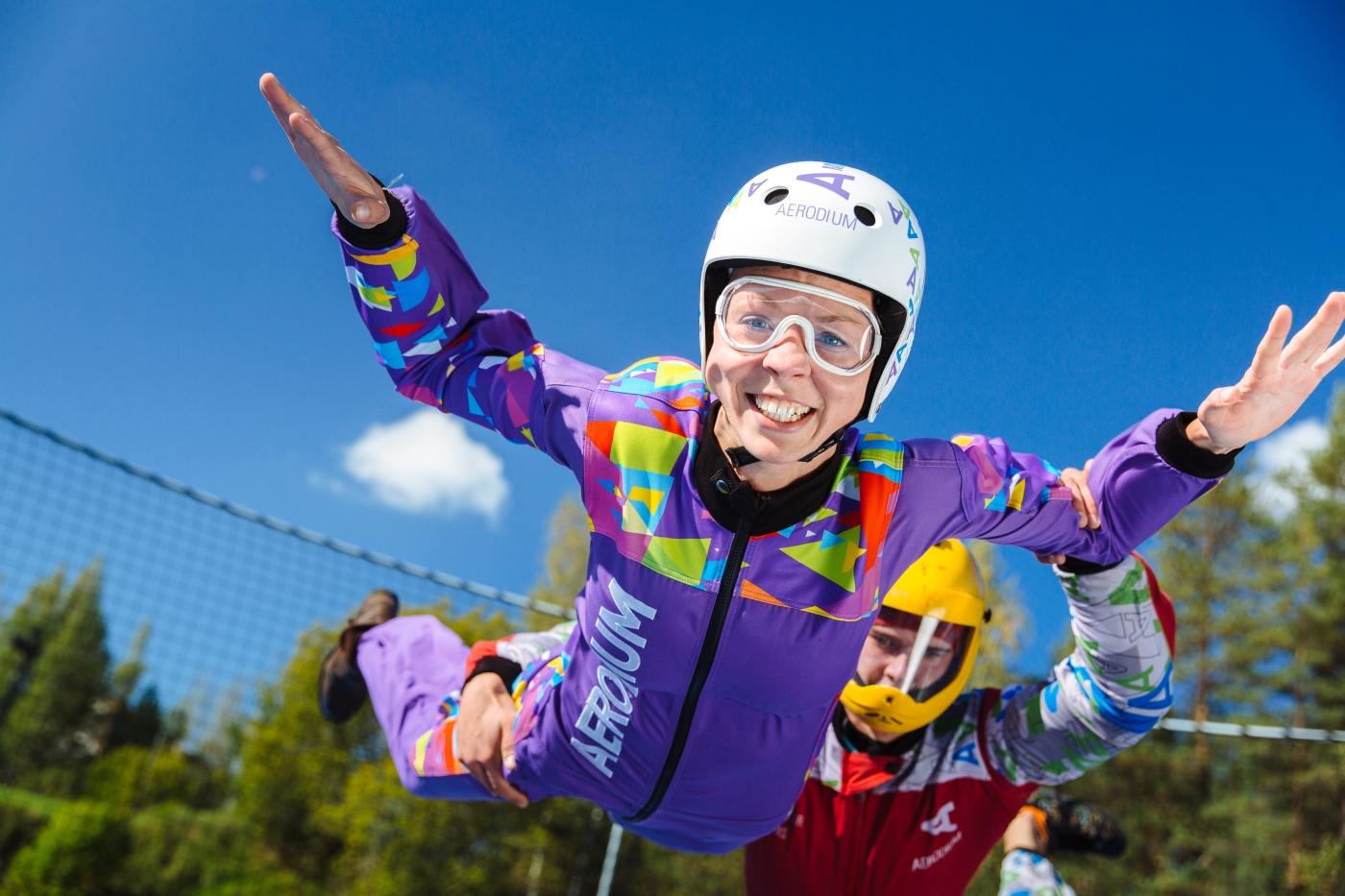
A wind tunnel lets you learn freefall body position in a safe, controlled environment.
Virtual reality simulators, once exclusive to military programmes, increasingly appear in civilian training and help lower the psychological barrier before a jump. Video analysis is now standard: every training jump is recorded, and the student reviews it with an instructor frame by frame to correct body-position errors faster.
Canopy materials and construction
Advances in canopy fabric mean modern parachutes are lighter, more durable, and more precisely controllable. Zero-porosity fabrics let almost no air pass through, which improves performance and extends a canopy's lifespan. For athletes in canopy piloting — the discipline of precision canopy flying — these materials mean greater control close to the ground.
These improvements are part of broader technological innovations in sport, where materials science and data gradually reshape even traditional disciplines.
Pro tip: if you're considering buying personal gear, consult a certified rigger before your purchase. Equipment that suits one style may not be optimal for another.
How did safety requirements change?
Safety in skydiving rests on three things — equipment, training, and standards — not on the sport being "risk-free." The main trend in 2025 is the harmonisation of international standards. Skydive Latvia operates to USPA and FAI standards and is the only such certified AFF training school in the Baltics.
That means the skills and documentation earned in Latvia are recognised internationally — a real advantage if you plan to jump abroad too. The standards set by the USPA (United States Parachute Association) and FAI (Fédération Aéronautique Internationale) define clear requirements for instructors, equipment, and how training is run.
| Standard element | What USPA/FAI practice requires | What it means for a new jumper |
|---|---|---|
| Instructor experience | The top-level (D) licence requires at least 500 solo jumps | You are taught only by experienced instructors |
| AAD for students | Mandatory during training in most countries | An extra automatic safety layer |
| AFF structure | A progressive programme split into levels | Controlled, step-by-step learning |
| Equipment upkeep | Regular rigger inspection and reserve repacking | Reliable, checked equipment |
Training increasingly includes mental preparation and stress management too. A jumper who knows how to stay calm under pressure makes better decisions in the air. You can read more about safety practice and common questions in our article on the most common skydiving questions.
Is skydiving getting more popular in Latvia?
Yes. Skydiving in Latvia is becoming more accessible and is spreading well beyond the traditional "extreme sports" crowd. The tandem jump is the main entry point, and a growing share of first-time jumpers continue with AFF training to become independent skydivers.
Several factors drive this demand. Social media plays a big role: jump videos create a "I want that too" effect. A tandem jump as a birthday or anniversary gift has become a popular choice among other adventure activities in Latvia. And finally — accessibility: a tandem jump requires no prior experience or special fitness, only a minimum age of 16 with parental consent.
In absolute numbers, Latvia remains a small market compared with larger European countries. But the direction is clear and follows the Scandinavian model, where skydiving has shifted from a niche sport to a more widely accessible activity. For a broader industry analysis, see our article on the challenges facing the skydiving industry.
What are the most popular skydiving styles?
Skydiving is not a uniform sport. Under one roof there are several disciplines, each with its own equipment and requirements. In Latvia there is a greater concentration on tandem and AFF formats, which makes sense in a smaller market. Here are the main styles in 2025.
Tandem jumps
The largest category by numbers and the first step for most people. A jump alongside an instructor, requiring no prior experience. In Latvia a tandem jump is from 4,000 m with around 60 seconds of freefall.
AFF (Accelerated Free Fall)
A structured training programme that lets you become an independent skydiver. AFF quality and participant numbers grew across the Baltics in 2025. Read more about the AFF training programme and the types of skydiving in Latvia.
Formation Skydiving (FS)
Group jumps in which several athletes build formations in freefall. The discipline is enjoying a revival thanks to video technology that allows precise analysis of each participant's position.
Canopy Piloting (CP)
The discipline of precision canopy flying, where athletes perform high-speed manoeuvres close to the ground. It demands a high skill level but is spectator-friendly and popular in competition.
Wingsuit jumps
Flight in a special suit that creates a wing effect. The sport keeps growing but requires significant base experience — typically at least 200 solo jumps before a first wingsuit flight.
Speed skydiving
A niche competition discipline in which the athlete reaches maximum speed in a vertical position in freefall — more than 500 km/h. That makes it one of the fastest sports in the world.
The premium format in Latvia is the Oxygen Jump — a high-altitude tandem jump from 5,500 m with oxygen equipment, the highest civilian tandem jump in Eastern Europe. It offers around 90 seconds of freefall, compared with about 60 seconds on a standard tandem jump.
What to expect in the future of skydiving
Forecasts in any sport call for caution, because the publicly available fragmentary data rarely give a full picture. Still, several trends are clear enough.
First, technology integration will continue. Artificial intelligence in training analysis and improved AAD algorithms are realistic directions. These technologies won't replace human judgment, but they will become an additional safety layer.
Second, accessibility will keep growing. Better information and a rising social-media presence mean ever more people will want to try the sport. Third, safety standards will continue to harmonise internationally, raising the overall safety level.
Challenges also exist. Climate change affects weather, which is a critical factor in skydiving — the season in Latvia (April–October) may become less predictable and demand more flexibility in planning. More complex airspace regulation, driven by drones and other unmanned systems, also creates new coordination requirements.
My take on where the sport is going
I've watched skydiving develop up close, and my main conclusion is simple: the biggest risk in this sport isn't physical but informational. People make decisions about jumps, equipment, and training based on unverified information online, and that is more dangerous than most technical shortcomings.
What I see in 2025 is positive: the industry is becoming more transparent. Certification standards are published, programmes are audited, and athletes increasingly ask the right questions before signing up. That cultural shift is worth more than any single technological innovation.
One thing worries me: the tendency to romanticise the "extreme" aspect at the expense of safety. My view is clear — skydiving is a great sport precisely because it combines freedom with discipline. One doesn't work without the other. In the future I see a sport that is both more accessible and safer; these two goals reinforce each other.
How to try skydiving in Latvia yourself
If these trends have made you want to feel freefall for yourself, getting started is simple. Skydive Latvia operates at Limbaži airfield, about an hour from Riga, and uses the legendary Pilatus Porter PC-6 aircraft. A tandem jump requires no experience — only the willingness to try.
| Tandem jump | Oxygen Jump | AFF training | |
|---|---|---|---|
| Altitude | 4,000 m | 5,500 m | up to 4,000 m |
| Freefall | ~60 sec | ~90 sec | progressive, by level |
| Price | €249 | €490 | from €1,790 (full course) |
| Best for | beginners | thrill-seekers | those who want to jump solo |

In this video you can see what a tandem jump with Skydive Latvia looks like, from exit to landing.
The season runs from April to October, and booking is straightforward. Our jumpers' reviews speak for themselves. The only question is: when will you jump?
Book a tandem jump Learn about the Oxygen Jump
Frequently asked questions
What are the main skydiving trends in 2025?
The main trends are more reliable AAD devices, wind-tunnel and video training, lighter zero-porosity canopies, and stricter, internationally harmonised safety standards. In Latvia, demand for tandem jumps and AFF training continues to grow.
Is skydiving safer in 2025 than before?
Modern equipment, stricter instructor standards, and digitised training methods together create a high level of safety. Still, no one can claim the sport is "risk-free" — safety rests on equipment, training, and following standards.
Which skydiving styles are most popular in Latvia?
Tandem jumps are the most popular by participant numbers, while AFF programmes see the fastest growth. Wingsuit and canopy piloting remain niche disciplines that require significant prior experience.
How do you start skydiving in Latvia?
The simplest start is a tandem jump, which needs no prior experience or special fitness. If you want to become an independent skydiver, the next step is USPA/FAI-certified AFF training.
How much does a tandem jump cost in Latvia?
A tandem jump at Skydive Latvia costs €249 (from 4,000 m, around 60 seconds of freefall). A photo-and-video package can be added for €89. The high-altitude Oxygen Jump from 5,500 m costs €490.
Has skydiving equipment changed in 2025?
Yes. New zero-porosity fabrics, more precise AAD algorithms, and wider use of video and wind-tunnel training are the main changes. They affect both safety and performance, especially for experienced athletes.

Skydive Latvia gift cards have no expiration date — the recipient can choose the best time and weather.